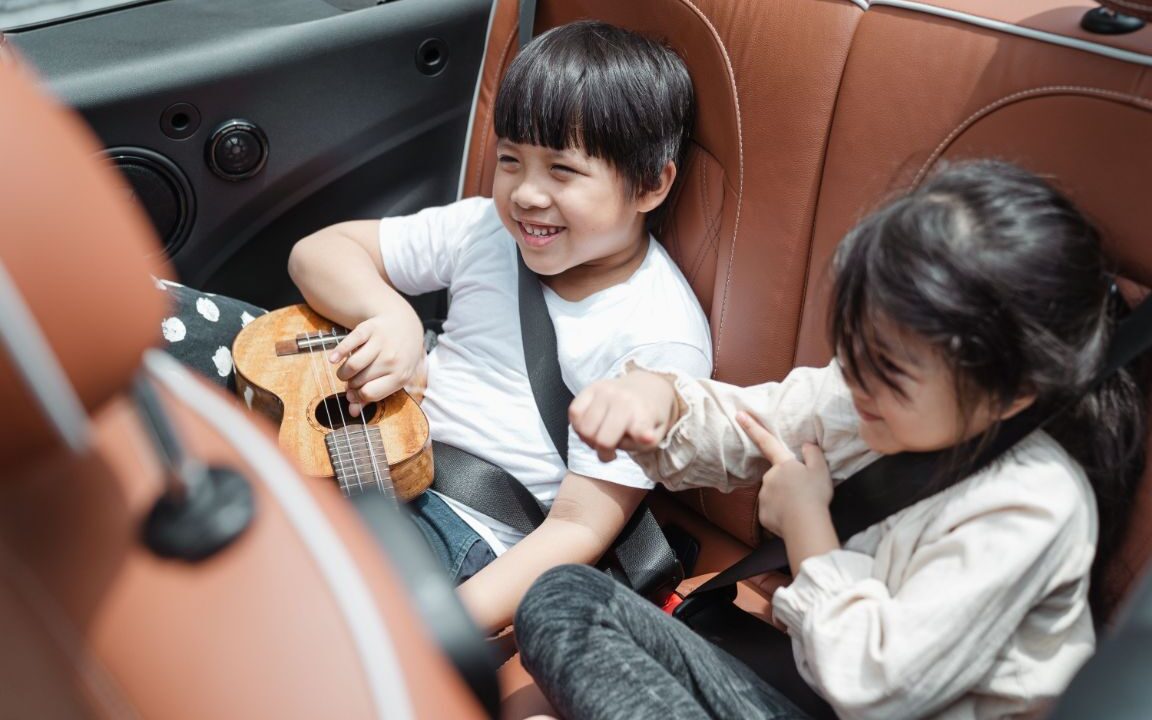
Before tablets, phones, and screens filled every quiet moment, a long car ride gave kids one big challenge:
Find something to do.
There were no downloaded shows waiting in the back seat. No headphones, no games loaded on a device, no endless scrolling when the road felt too long.
There was the window.
There was the map.
There were snacks, songs, siblings, road signs, and whatever game someone could invent before the next gas station.
And somehow, that was enough.
The Back Seat Had Its Own Rules
A family road trip could feel exciting at the beginning.
Everyone had a seat. Bags were packed. Snacks were handed out. The destination seemed far away in the best possible way.
Then, after an hour or two, the questions started.
“How much longer?”
“Can we stop?”
“He is touching my side.”
“I am bored.”
That was when the games began.
Someone looked for license plates from different states. Someone else started counting red cars. A parent suggested the alphabet game, where every letter had to be found on road signs before the trip was over.
The games were simple because they had to be.
They used whatever was already there.
License Plates, Signs, and Things Outside the Window
The road itself became part of the entertainment.
License plates were not just plates. They were clues.
A car from another state felt important because it meant someone else had come a long way too. Kids kept lists on paper, called out new plates, and sometimes argued about whether a state had already been counted.
Road signs became part of the game too.
Find every letter of the alphabet.
Spot the next state line.
Look for an animal on a billboard.
See who can find the strangest town name.
Count how many trucks pass the car.
The landscape gave children something to watch because there was little else competing for attention.
A field of cows could become a game.
A giant roadside sign could become a story.
A strange building beside the highway could keep everyone talking for miles.
Travel Bingo and Folded Paper Games
Some families came prepared.
There might be travel bingo cards in the glove compartment. A pad of paper and pencils might be passed to the back seat. Someone might bring a deck of cards, a puzzle book, or a small magnetic game that was supposed to stay on the tray but never really did.
Other games were made up as the trip went along.
Twenty Questions.
Would You Rather.
Guess the song on the radio.
Name something that starts with the next letter.
Tell a story one sentence at a time.
The rules changed often. The arguments changed even faster.
But those games gave the ride a rhythm.
There was a beginning, a middle, and an end to each small challenge. And every game helped move the car a little farther down the road.
The Map Was a Game Too
Before GPS, maps were not only for the adults in the front seat.
Kids looked at them too.
They followed the line across states. They searched for the next town. They tried to find the road they were on. They asked how far away the destination was and stared at the map until the answer somehow felt more believable.
Sometimes a parent let a child hold the map.
That felt important.
The paper was too big, the folds never worked properly, and it was easy to lose your place. But the map made the trip feel real. It showed that the world was bigger than the car, bigger than the highway, and full of places with names you had never heard before.
The Radio Did More Work Than People Remember
The radio helped too.
Songs came on that everyone knew. Songs came on that nobody liked. A parent changed the station. Someone in the back seat asked for the old station again.
Families sang along badly.
Kids learned lyrics they were probably too young to understand.
A song could become connected to one particular trip, one particular summer, or one long stretch of road where everyone was tired but still awake.
Years later, the song might come on somewhere else and bring the whole car ride back.
The snacks.
The window.
The seat belt rubbing against your shoulder.
The feeling of looking out at a place you had never seen before.
Then vs. Now
| Then | Now |
|---|---|
| Kids made games from road signs, maps, and the scenery | Passengers often use personal screens and apps |
| License plates and billboards became part of the ride | Navigation and entertainment are usually digital |
| Families shared one radio and one view from the car | Everyone may have separate devices and headphones |
| Boredom often led to games, stories, or conversation | Boredom can be solved quickly with a screen |
| Long drives created shared memories in one space | Travel can feel more individualized inside the same car |
Not everything about the old way was easier.
Some drives were long. Some games became repetitive. Some arguments lasted far too long.
But the limited choices gave families something unexpected: shared time.
Boredom Was Part of the Story
Today, boredom often feels like something to fix immediately.
But on old road trips, boredom had nowhere to go.
You looked out the window.
You listened to the adults talk.
You made up a game.
You fell asleep.
You woke up and asked where you were.
You watched the sky change.
Those quiet stretches became part of the memory too.
The road was not always exciting. But it made room for small things to happen.
A joke that kept going for hours.
A song everyone sang.
A snack that melted in the car.
A game nobody finished because the family finally reached the motel.
These moments were not planned. That was why they lasted.
Why These Games Still Matter
Road trip games were never really about winning.
They were about making the distance feel smaller.
They gave children something to do together. They gave parents a way to keep the peace. They turned ordinary signs, cars, maps, and songs into part of the trip.
And they made the back seat feel like its own little world.
No matter where the family was going, there was always another sign to read, another plate to spot, another song on the radio, and another question about how much longer it would take.
Sources & Further Reading
- John Margolies Photographs of Roadside America — Library of Congress background on the roadside culture of motels, diners, gas stations, signs, and other places that shaped travel by car.
- Free to Use and Reuse: Cars — Library of Congress image collection featuring classic cars and road-travel imagery.
- How to Do Oral History — Smithsonian Archives guidance that includes prompts about childhood games, hobbies, and the memories people carry from earlier life.
Do You Remember This?
What games did your family play on road trips?
Maybe you remember license plates, travel bingo, counting cars, reading maps, singing along to the radio, or trying to make the trip go faster.
Do you remember this? Share your memory below.

Join the Conversation
What Do You Remember?
Did this story bring back a memory? Tell us below, or share a longer story on the Memory Wall.
Share a Full Memory