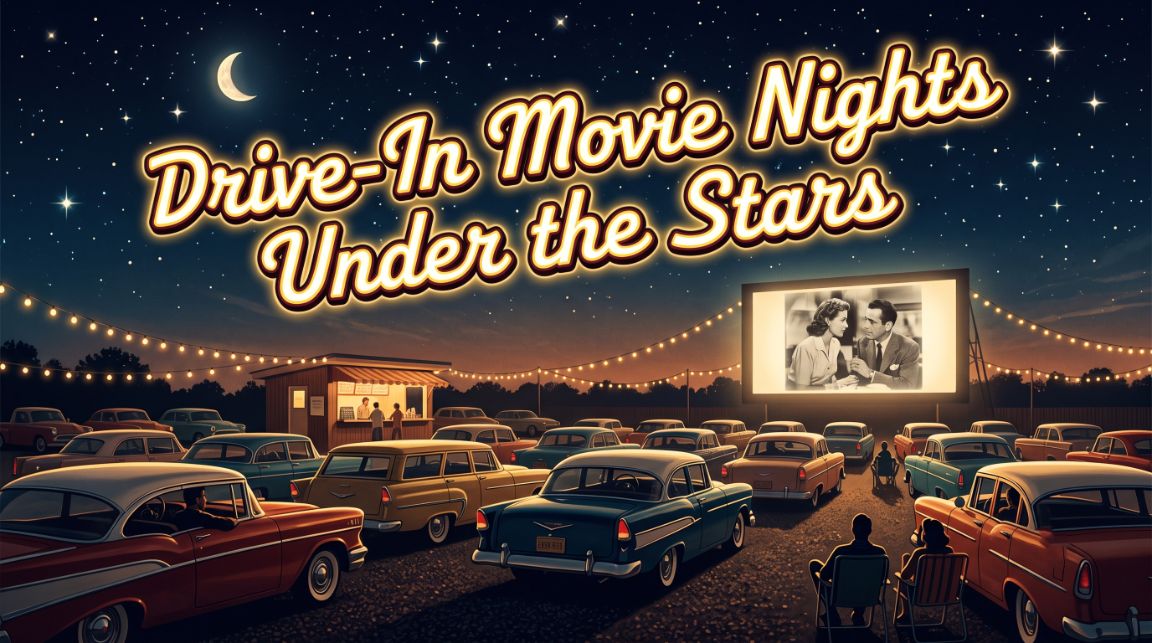
Before streaming, before reserved seats, before recliners in movie theaters, families sometimes watched movies from the front seat of a car.
The screen stood tall against the night sky.
Cars lined up in rows.
Children climbed into the back seat with pillows, blankets, popcorn, and candy.
Parents adjusted the speaker on the window or tuned the radio to the right station.
The movie might not start until the sun went down.
That waiting was part of it.
A drive-in movie was not only about watching a film.
It was about being outside, together, in the dark, with the whole evening stretched out in front of you.
The Night Began Before the Movie Did
A drive-in night often started at home.
Someone packed snacks.
Someone reminded the kids to bring a sweater.
Someone looked for blankets.
Someone said they were leaving early to get a good spot.
The family car became part movie seat, part picnic table, part bedroom for the youngest children.
By the time everyone arrived, the evening already felt different from an ordinary trip to the movies.
There was room to move around.
There was fresh air.
There were other families nearby, all waiting for the same screen to come alive.
Kids watched the sky get darker and asked when the movie would start.
The answer was always some version of “soon.”
The Screen Looked Huge From the Car
A drive-in screen felt different from an indoor theater screen.
It stood alone.
You could see it from far away.
It rose above the parked cars, the snack bar, the speaker posts, and the dark outline of trees or highway signs beyond the lot.
Before the movie began, the blank screen almost felt like part of the landscape.
Then the projector started.
The image appeared.
The whole parking lot quieted.
For a child in the back seat, it could feel almost magical.
You were watching a movie, but you were also aware of everything around it — the night air, the car seats, the dashboard lights, the smell of popcorn, and the sound coming through the speaker.
The Speaker on the Window
Older drive-ins had small speakers that hung on the car window.
They were part of the memory.
The speaker had a cord.
It had a metal body.
It made the movie sound a little thin, a little crackly, and somehow perfect for the place.
Someone had to roll the window down just right. Someone had to remind everyone not to drive away before putting the speaker back.
Later, many drive-ins used car radios instead, but people who remember the old speaker posts often remember them clearly.
They were part of the ritual.
Pull in.
Park.
Hang the speaker.
Settle in.
Wait for the movie.
The Concession Stand Was Half the Fun
At some point, someone always wanted to go to the concession stand.
It might have had popcorn, hot dogs, candy, soda, nachos, coffee, or ice cream.
Sometimes there were cartoons or reminders on the screen telling people to visit the snack bar before the feature started.
For kids, walking to the concession stand in the dark felt like a small adventure.
The gravel under your shoes.
The glow from the building.
The line of other families.
The smell of popcorn getting stronger as you got closer.
You came back to the car carrying food carefully, trying not to spill anything before the movie began again.
The snack was not just a snack.
It was part of the night.
Kids Rarely Made It to the End
Drive-in movies were family events, but they often lasted late.
Children might start the night excited, sitting up, asking questions, and eating too much candy.
Then the second feature started.
The blankets came out.
Someone leaned against the car door.
Someone stretched across the back seat.
By the time the family left, at least one child was usually asleep.
That was one of the sweetest parts of the memory.
The movie kept playing.
The adults kept watching.
The kids drifted off under blankets while the screen flickered outside the windows.
Then came the quiet drive home.
Then vs. Now
| Then | Now |
|---|---|
| Families watched from their own car under the night sky | Movies are often streamed at home or watched in indoor theaters |
| Sound came through window speakers or the car radio | Audio is digital, private, and controlled |
| Snacks came from a concession stand or home-packed bags | Food can be ordered, delivered, or paused around |
| Kids often fell asleep in the back seat before the movie ended | Movies can be paused and finished later |
| The outing felt tied to summer nights, cars, and open space | Watching is often more convenient but less of an event |
Not everything about drive-ins was perfect.
The weather mattered.
The sound was not always clear.
Mosquitoes could be annoying.
A tall vehicle in front could block part of the screen.
But those imperfections became part of the story.
Drive-Ins Belonged to Car Culture
Drive-in theaters grew with the rise of automobile culture.
They made sense in a world where families were driving more, suburbs were expanding, and entertainment could spread beyond downtown movie houses.
A drive-in was built around the car.
The parking rows.
The speaker posts.
The wide outdoor screen.
The snack bar.
The entrance sign meant to catch attention from the road.
Some drive-ins became local landmarks. Others stood along highways, near towns, or on the edges of growing communities. Like diners, motels, and gas stations, they became part of roadside life.
Why People Still Miss Drive-In Nights
People miss drive-ins because they combined simple things in a memorable way.
A movie.
A car.
A summer night.
A blanket.
A snack bar.
A family sitting together in a place that felt public and private at the same time.
You were surrounded by other people, but still inside your own little space.
You could talk quietly.
You could bring children.
You could sit under the stars instead of under a theater ceiling.
The movie itself may fade from memory.
But the feeling stays.
The speaker on the window.
The glow of the screen.
The rows of cars.
The tired ride home.
That was the magic of a drive-in night.
Do You Remember This?
Did your family ever go to a drive-in movie?
Maybe you remember the speaker on the window, the concession stand, the blankets in the back seat, the second feature, or falling asleep before the movie ended.
Do you remember this? Share your memory below.
Join the Conversation
What Do You Remember?
Did this story bring back a memory? Tell us below, or share a longer story on the Memory Wall.
Share a Full Memory