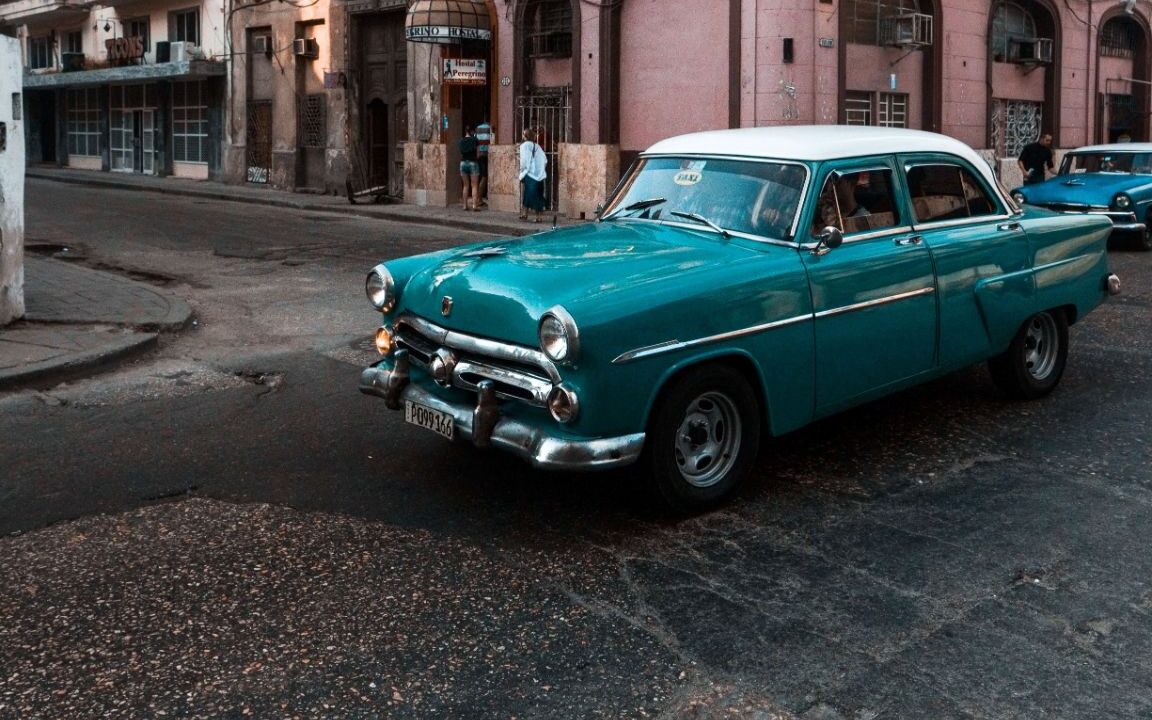
A car from the 1950s rarely tried to disappear into traffic.
It arrived with chrome around the windows, chrome across the grille, chrome along the sides, and sometimes enough chrome on the dashboard to catch the afternoon sun.
The body might be painted in two colors.
The hood ornament pointed toward the road.
The steering wheel was wide and thin.
A broad bench seat stretched across the front.
By the end of the decade, tailfins rose from the rear fenders like pieces of an airplane or rocket.
These cars were transportation, but they were also part of the way families experienced a changing country.
They carried children to school, parents to work, teenagers to drive-ins, and families toward roadside motels, national parks, diners, beaches, and relatives who lived several states away.
For many people, the most memorable car of the 1950s was not a rare collector model.
It was the car that sat in the driveway.
What Made 1950s Cars Look So Different?
The cars of the 1950s were shaped by postwar confidence, expanding suburbs, growing highway travel, and public fascination with aircraft, rockets, and new technology.
Common design features included:
- Large chrome grilles
- Tailfins
- Hood ornaments
- Two-tone paint
- Wraparound windshields
- Whitewall tires
- Bench seats
- Long bodies
- Rounded fenders
- Decorative side trim
- Large steering wheels
- Column-mounted gear shifters
- Dashboard radios
- Prominent manufacturer emblems
- Spacious trunks
- Station-wagon cargo areas
Not every car had every feature.
An early-1950s family sedan could still appear rounded and restrained compared with the dramatic cars that arrived near the decade’s end. Styling changed quickly, and manufacturers regularly redesigned grilles, lights, trim, and body shapes to make each new model year recognizable.
A person who knew cars could often identify the year from a single piece of chrome.
Chrome Became Part of the Personality
Chrome was one of the defining visual features of the decade.
It surrounded headlights.
It crossed grilles.
It outlined windows.
It ran in bright strips along doors and fenders.
It appeared on bumpers, mirrors, handles, dashboards, emblems, and hood ornaments.
Manufacturers used chrome to make cars look polished, expensive, and modern. Even an ordinary family sedan could gain a sense of occasion from a wide grille and carefully placed trim.
Keeping all that metal bright required work.
Cars were washed in driveways.
Bumpers were polished.
Children were handed cloths and told to help.
A clean car reflected the sky, the house, and anyone standing close enough to admire it.
Chrome also made minor damage difficult to ignore. A dented bumper or missing piece of trim stood out clearly on a car whose appearance depended so much on shine.
Two-Tone Paint Made Cars More Recognizable
Many 1950s cars used two paint colors on the same body.
A white roof might sit above a turquoise body.
Black could be paired with red.
Cream could appear beside blue, green, pink, or yellow.
The colors were separated by windows, rooflines, chrome strips, or sculpted sections of the body.
Two-tone paint made a car easier to recognize from a distance. It also allowed buyers to choose combinations that felt more personal than a single conservative color.
Some combinations were subtle.
Others looked almost playful.
A bright car parked outside a diner, motel, or suburban house became part of the scenery people now associate with the decade.
The paint might fade over time, but the color combination stayed in family memory.
Tailfins Grew With the Decade
Tailfins began appearing before the 1950s, but the decade turned them into one of the most recognizable features in automotive history.
Early fins were modest extensions rising from the rear fenders.
As the years passed, they became taller, sharper, and more dramatic.
Designers drew inspiration from aircraft and the growing fascination with jet travel and space exploration. Cars gained shapes that suggested movement even while parked.
By 1959, some tailfins had reached astonishing proportions.
They framed taillights, sharpened the silhouette, and made the rear of the car as important as the grille.
Not every driver loved them.
Not every manufacturer used them in the same way.
But tailfins captured the confidence of a period that believed the future should look visibly different from the past.
The 1957 Chevrolet Bel Air Became an Icon
Few cars represent the 1950s as clearly as the 1957 Chevrolet Bel Air.
Its combination of chrome, rear fins, two-tone color options, and distinctive side trim helped make it one of the most recognizable American cars ever produced.
The Bel Air was not only a stylish object.
It belonged to a broader Chevrolet lineup that families could use for commuting, errands, vacations, and everyday life.
A well-kept example now attracts attention at car shows, but the model’s emotional power comes partly from the fact that it once appeared on ordinary streets.
It parked outside schools.
It waited in supermarket lots.
It carried families along new highways.
It sat beneath carports and beside small suburban homes.
For people who grew up around one, its shape is attached to real memories rather than museum displays.
The Corvette Offered a Different Dream
Chevrolet introduced the Corvette in 1953.
It was a smaller, sportier car than the large family sedans and station wagons that filled American roads.
The early Corvette had a fiberglass body, a two-seat layout, and styling intended to compete with European sports cars while creating something distinctly American.
Most families did not own one.
That was part of the appeal.
The Corvette represented a different version of driving—less about carrying groceries and children, and more about freedom, style, speed, and attention.
A child might see one passing on the street and turn to look.
A teenager might imagine owning one someday.
A driver might recognize it immediately from the shape.
The Corvette helped show that 1950s car culture included both practical family transportation and vehicles built around aspiration.
Cadillac Pushed Tailfins Further
Cadillac played a major role in making tailfins fashionable.
Its late-1940s designs introduced modest fins inspired by aircraft, and the feature grew steadily through the following decade.
By the end of the 1950s, Cadillac fins had become tall, sharp, and visually impossible to ignore.
The 1959 Cadillac is especially remembered for its enormous fins and bullet-shaped taillights.
It represented the peak of the styling trend.
The car looked long, low, wide, and almost theatrical.
It did not suggest restraint.
It suggested arrival.
Even people who have little interest in automobiles often recognize the silhouette as something from the late 1950s.
Ford Brought Style to the Family Driveway
Ford remained a major part of family car ownership throughout the decade.
Models such as the Fairlane, Customline, Mainline, and later Galaxie appeared in sedans, hardtops, convertibles, and station wagons.
Ford designs followed many of the decade’s larger trends:
- Wider bodies
- Wraparound windshields
- More chrome
- Lower rooflines
- Two-tone paint
- Growing fins and sculpted rear sections
A Ford parked in the family driveway might not have seemed historically important.
It was simply the car everyone used.
That ordinary role is exactly why these models now bring back strong memories.
They were present during school mornings, grocery trips, Sunday drives, family vacations, and the first nervous driving lessons of a new teenager.
The Thunderbird Mixed Sport and Comfort
Ford introduced the Thunderbird for 1955.
Although it was often compared with the Corvette, the Thunderbird placed greater emphasis on comfort and personal luxury.
It offered sporty styling without giving up the polished feeling many American buyers expected.
The Thunderbird appealed to drivers who wanted something more exciting than a family sedan but more refined than a stripped-down sports car.
Its long hood, two-seat layout, removable hardtop, and distinctive styling made it memorable from the beginning.
The car also helped establish the idea of the personal luxury vehicle—a car chosen not mainly for family size or cargo space, but for the pleasure and image of the person driving it.
Station Wagons Carried Family Life
The glamorous cars received most of the advertising attention, but station wagons did much of the decade’s practical work.
They carried:
- Children
- Luggage
- Groceries
- Picnic baskets
- Camping equipment
- Beach supplies
- School projects
- Sports gear
- Holiday presents
A station wagon offered a long roof and a large rear cargo area. Some models used wood or wood-look trim that connected them to earlier “woodie” wagons.
The rear seat could become crowded with siblings.
The cargo area might hold bags, coolers, blankets, and things that shifted whenever the car turned.
Some children rode in positions that would not meet modern safety standards. Seat belts were not yet an ordinary part of every passenger’s routine, and the open cargo space could feel like a small room on wheels.
For many families, the station wagon was the vehicle that made road trips possible.
Bench Seats Put Everyone Together
Front bench seats stretched from one door to the other.
Instead of separate driver and passenger seats divided by a console, the front of the car offered one wide cushion.
A child could sit between two adults.
Couples could sit close together.
A family could fit three people across the front when necessary.
The seat changed the feeling of the interior.
People were not placed into individual compartments.
They shared one continuous space.
The arrangement also created memories that modern cars rarely reproduce.
A child watched the road from the middle.
A parent’s arm rested across the top of the seat.
Someone slid slightly during a sharp turn.
The driver shifted gears from the steering column instead of reaching toward a center console.
The front bench made the car feel like one room.
Dashboards Had Their Own Style
A 1950s dashboard could be as decorative as the exterior.
Large speedometers sat behind the steering wheel.
Chrome rings surrounded gauges.
Knobs controlled lights, ventilation, wipers, and the radio.
Some dashboards used body-colored paint or two-tone details that continued the exterior design inside the car.
The radio occupied a place of importance.
Drivers turned a dial and searched for a clear station. Music, baseball games, news, weather, and advertisements filled the car.
Reception changed as the road continued.
A station faded.
Another appeared.
On a family trip, the dashboard became the control center for the entire journey.
The map might rest nearby.
Coins waited for tolls.
A paper cup sat somewhere it was not especially secure.
The driver watched the road through a large windshield while everyone else watched the scenery.
Starting the Car Was a Physical Routine
Driving a 1950s car involved sensations newer vehicles have softened or removed.
The key turned.
The engine cranked.
The starter made its effort clearly known.
On a cold morning, the driver might need patience.
Some cars required attention to a choke or accelerator routine.
The engine could idle loudly before settling down.
Steering without power assistance required strength, especially while parking.
Braking demanded more planning than it does in a modern car.
The vehicle communicated through vibration, sound, and movement.
Drivers learned the personality of their own car.
They knew which noise was ordinary.
They noticed when something sounded wrong.
They understood how long the engine needed to warm up and how much space was required to stop.
Cars Needed Regular Attention
A family car was not always expected to operate for months without anyone looking under the hood.
Drivers checked oil.
Service-station attendants checked fluid levels and tire pressure.
Engines needed tune-ups.
Batteries needed attention.
Tires wore out.
Belts loosened.
Cooling systems overheated.
A car might be dependable, but dependability still involved maintenance.
Many owners knew more about basic vehicle care because problems were harder to ignore.
A father, neighbor, mechanic, or older sibling might spend part of a Saturday leaning over the engine.
Children watched from nearby.
Tools were passed back and forth.
Hands became greasy.
The car connected family transportation with a kind of mechanical knowledge that has become less common as vehicles have grown more complex.
Full-Service Gas Stations Were Part of Driving
A gas-station stop could include more than filling the tank.
An attendant might:
- Pump the gasoline
- Clean the windshield
- Check the oil
- Inspect the tires
- Add water or coolant
- Give local directions
The driver often remained inside the car.
Children watched the pump numbers turn.
Someone asked to use the restroom.
Someone else looked at maps, postcards, gum, or cold drinks inside the station.
The smell of gasoline, the sound of the bell hose, and the scrape of the windshield squeegee became part of the driving experience.
The station was not only a place to pay.
It was part of the road.
The Interstate Changed Where Cars Could Go
The Federal-Aid Highway Act of 1956 accelerated construction of the Interstate Highway System.
The new roads changed travel by connecting cities and regions through limited-access highways designed for faster, longer-distance driving.
For families, this helped make vacations by car more practical.
Destinations that once required slow travel through many towns became easier to reach.
Roadside businesses expanded around automobile travelers:
- Motels
- Gas stations
- Diners
- Drive-ins
- Tourist attractions
- Rest areas
- Shopping centers
The car was no longer only a way to move around town.
It became a tool for exploring the country.
The Sunday Drive Could Be the Destination
Not every car trip needed a major purpose.
Families took Sunday drives simply to get out of the house.
They followed country roads.
They visited relatives.
They stopped for ice cream.
They drove past new houses, farms, construction sites, rivers, or parks.
Children looked through the windows and asked where they were going.
Sometimes the answer was nowhere in particular.
Gas was used for the pleasure of movement and the chance to see something beyond the neighborhood.
The car turned an ordinary afternoon into a small outing.
Drive-Ins Were Built Around the Car
The automobile shaped entertainment as well as transportation.
Drive-in restaurants served people without requiring them to leave the vehicle.
Carhops carried trays to windows.
Teenagers gathered in parking lots.
Families ate burgers, fries, shakes, and ice cream while sitting inside or beside the car.
Drive-in movie theaters turned the vehicle into a private viewing space.
Families brought children, blankets, and snacks. A speaker hung from the window, and the movie began after dark.
The car made these experiences possible.
It was not merely parked outside the entertainment.
It was part of it.
Teenagers Found a New Kind of Independence
For teenagers, access to a car could change social life.
A car meant the possibility of going somewhere without parents sitting beside them.
It meant picking up friends.
Driving to a game.
Going to a diner.
Attending a dance.
Watching a movie.
Taking the long way home.
Not every teenager owned a car, and many borrowed a family vehicle under strict conditions.
Bring it back by a certain time.
Do not use too much gas.
Do not let anyone else drive.
Keep it clean.
Even with rules, the car offered a taste of independence.
It became part of dating, friendship, music, work, and the transition into adulthood.
Family Cars Appeared in Important Photographs
Cars often appeared in family albums because ownership felt significant.
A family posed beside a new purchase.
Someone photographed the car in the driveway.
Children stood near the bumper.
The picture might include the house, lawn, and neighborhood in the background.
These images preserved more than the vehicle.
They captured a moment when the family had acquired something valuable and useful.
The car might later be traded, damaged, sold, or passed to a teenager.
But the photograph remained.
Decades later, people could identify the year of their childhood by the car parked behind them.
Popular 1950s Cars People Still Remember
The decade produced many vehicles that remain recognizable today.
Among them were:
- Chevrolet Bel Air
- Chevrolet Corvette
- Chevrolet Nomad
- Ford Thunderbird
- Ford Fairlane
- Ford Crown Victoria
- Cadillac Series 62
- Cadillac Eldorado
- Buick Roadmaster
- Buick Century
- Oldsmobile 88
- Oldsmobile 98
- Pontiac Chieftain
- Pontiac Star Chief
- Chrysler New Yorker
- Chrysler 300
- Plymouth Fury
- Mercury Monterey
- Studebaker Champion
- Studebaker Commander
- Nash Metropolitan
- Hudson Hornet
- Packard Caribbean
This is not a complete list.
The family car people remember most may have been a less glamorous sedan, wagon, pickup, or compact model.
Historical fame and personal importance are not always the same thing.
Cars Were Not Equally Accessible to Everyone
The image of carefree 1950s driving can hide important realities.
A new car was expensive.
Many families bought used vehicles, kept older cars running, shared one vehicle, or relied on public transportation.
Road travel was also not equally safe or welcoming for every American.
Black motorists faced discrimination and segregation at hotels, restaurants, gas stations, and other businesses. Travel guides such as The Negro Motorist Green Book helped families identify places where they could expect safer service.
The open road represented freedom, but that freedom was limited by race, income, location, and access.
A truthful history of 1950s car culture must make room for both the optimism and the barriers.
Then vs. Now
| Then | Now |
|---|---|
| Chrome, hood ornaments, and model-specific styling dominated the exterior | Aerodynamics, safety, efficiency, and shared platforms shape many designs |
| Two-tone paint was widely available | Most new vehicles use one primary exterior color |
| Front bench seats could hold three people | Separate bucket seats and center consoles are standard |
| Tailfins and decorative trim made model years easy to identify | Year-to-year styling changes may be more subtle |
| Radios relied on local broadcasts and manual tuning | Drivers use satellite radio, streaming, podcasts, and navigation |
| Paper maps guided long trips | GPS provides live directions and traffic information |
| Service-station attendants handled many basic checks | Most fuel stops are self-service |
| Seat belts were not yet a routine part of every seat | Seat belts, airbags, child seats, and crash engineering are fundamental |
| Cars required frequent mechanical attention | Modern vehicles generally need less frequent routine adjustment |
| Families often shared one main vehicle | Many households own more than one vehicle |
| A new car was photographed as a major family purchase | Cars remain important, but photographs are less ceremonial |
Why 1950s Cars Still Stand Out
The cars of the 1950s remain memorable because designers allowed them to be expressive.
A grille could look proud.
A hood ornament could suggest motion.
A color combination could be cheerful.
A tailfin could become taller simply because the next model needed to look newer than the last.
The cars also belonged to a moment when driving was reshaping everyday life.
Suburbs expanded.
Highways grew.
Roadside businesses appeared.
Family vacations became more closely tied to the automobile.
Teenagers gained a new symbol of independence.
The vehicle moved from being a useful machine to becoming part of personal identity and family memory.
Why People Remember the Family Car
Most people do not remember horsepower figures or factory option codes.
They remember where they sat.
They remember the smell of the upholstery.
They remember the sound of the door closing.
They remember the wide steering wheel and the radio dial.
They remember the heat of the vinyl seat in summer.
They remember sleeping against a sibling during a long trip.
They remember a parent’s hands on the wheel.
They remember seeing their house through the rear window as the family drove away.
The car became part of the setting of childhood.
It waited in the driveway every morning.
It appeared behind people in photographs.
It carried the family through ordinary errands and important occasions.
That is why an old Chevrolet, Ford, Buick, Cadillac, Plymouth, or station wagon can bring back more than an interest in automotive design.
It can bring back the people who once rode inside.
Quick Answers About 1950s Cars
What were the most popular cars of the 1950s?
Commonly remembered models include the Chevrolet Bel Air, Ford Fairlane, Ford Thunderbird, Chevrolet Corvette, Cadillac Eldorado, Oldsmobile 88, Buick Roadmaster, Plymouth Fury, Chrysler 300, and several family station wagons.
Why did 1950s cars have tailfins?
Tailfins were inspired partly by aircraft styling and the era’s fascination with jets, rockets, and futuristic design. Manufacturers also used them to make new model years visually distinctive.
Why was there so much chrome on 1950s cars?
Chrome made cars look polished, modern, and expensive. Manufacturers used it on grilles, bumpers, windows, side trim, dashboards, and decorative details.
Did all 1950s cars have seat belts?
No. Seat belts were not yet standard equipment across all cars and seats. Availability and adoption increased over time, but many families drove without using them during the decade.
What was the most iconic car of the 1950s?
There is no single answer, but the 1957 Chevrolet Bel Air, 1959 Cadillac, Ford Thunderbird, and Chevrolet Corvette are among the decade’s most recognizable cars.
Were station wagons popular in the 1950s?
Yes. Station wagons offered practical cargo space for growing families, groceries, vacations, outdoor equipment, and everyday errands.
Sources & Further Reading
- When Tail Fins Made Waves — Smithsonian history of the development of automotive tailfins and their connection to aircraft-inspired styling.
- Designed to Sell — National Museum of American History material showing how automotive styling and Cadillac tailfins changed across the 1950s.
- Mission 66 Background and History — National Park Service background on postwar automobile ownership, family travel, suburban growth, and expanding visits to national parks.
- Postwar Years: 1945–1960 — National Park Service history of automobile travel and the motels and roadside businesses that developed to serve motorists.
- National Interstate and Defense Highways Act — National Archives overview of the 1956 legislation that established the Interstate Highway System.
- GM Heritage Archive — General Motors collection of historical vehicle information kits for Chevrolet, Cadillac, Buick, Oldsmobile, and other models.
- America on the Road: The Family Vacation by Car — Library of Congress history of automobile vacations, road trips, and changing family travel.
- Green Book Properties in the National Register — National Park Service background on the travel barriers Black motorists faced and the businesses that offered safer service.
Do You Remember This?
What car does the 1950s bring back for you?
Maybe you remember a Chevrolet in the driveway, a Ford station wagon packed for vacation, a Cadillac passing through town, or the first car someone in your family was proud to own.
What color was it, and where did it take you?
Do you remember this? Share your memory below.


Join the Conversation
What Do You Remember?
Did this story bring back a memory? Tell us below, or share a longer story on the Memory Wall.
Share a Full Memory