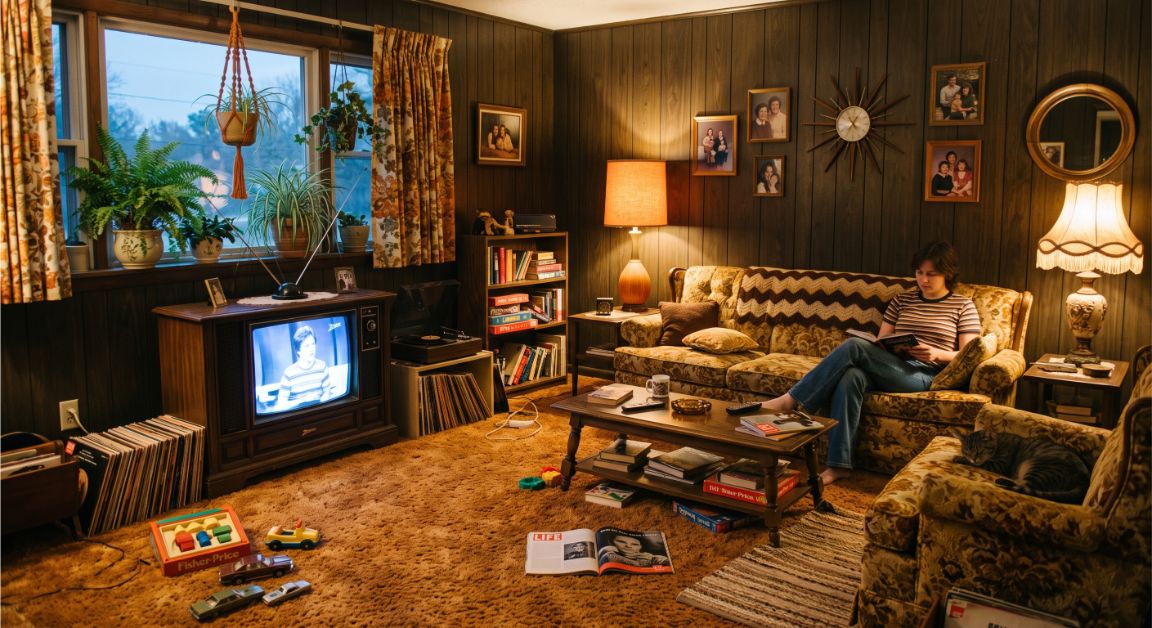
A 1970s home was rarely afraid of color.
The kitchen might have an avocado-green refrigerator. The family room might have dark wood paneling, orange carpet, and a floral sofa. Plants hung near the windows, lamps filled the room with warm yellow light, and the television sat inside a wooden cabinet large enough to feel like part of the furniture.
Even homes that were not professionally decorated absorbed the look of the decade.
A new appliance here.
A patterned curtain there.
A piece of wicker furniture in the corner.
A crocheted blanket across the back of the couch.
For many people, these details are more than design trends. They are part of the background of childhood.
The colors, textures, furniture, and objects of the decade became connected to family dinners, television nights, holidays, relatives, and ordinary afternoons at home.
What Did 1970s Home Decor Look Like?
1970s interiors were warm, textured, and often visually busy.
Common features included:
- Avocado green
- Harvest gold
- Burnt orange
- Chocolate brown
- Mustard yellow
- Wood paneling
- Shag carpeting
- Floral wallpaper
- Geometric patterns
- Low sofas and sectionals
- Wicker and rattan furniture
- Macramé wall hangings
- Hanging houseplants
- Beanbag chairs
- Mushroom-shaped lamps
- Chrome-and-glass tables
- Vinyl upholstery
- Console televisions
- Home bars
- Conversation pits
- Dark wood cabinets
- Patterned laminate counters
Not every home included all of these elements.
Most family homes were mixtures of several decades. Furniture was expensive, so people kept older tables, chairs, cabinets, and lamps for years. A new 1970s sofa might sit beside a table from the 1950s. A modern television might face a chair inherited from a grandparent.
Real homes changed slowly.
That mixture helped make them feel personal.
Earth Tones Filled the House
The decade is strongly remembered for its earth-toned color palette.
Brown appeared in wood paneling, sofas, carpet, furniture, and kitchen cabinets.
Green appeared on appliances, countertops, bathroom fixtures, curtains, and wallpaper.
Orange appeared in cushions, carpet, lamps, and upholstery.
Gold appeared on refrigerators, stoves, telephones, bedspreads, and kitchen floors.
These colors were often used together.
A family room could have brown walls, green chairs, an orange sofa, and gold carpet without anyone thinking the combination was too much.
Under the soft light of table lamps and floor lamps, the colors made rooms feel enclosed, warm, and comfortable.
Today, some of these shades seem unmistakably retro. At the time, they simply looked current.
Wood Paneling Created the Family-Room Look
Few surfaces are more strongly connected with 1970s interiors than wood paneling.
It appeared in family rooms, basements, dens, recreation rooms, hallways, and sometimes entire houses.
Some paneling was real wood. Much of it was manufactured to create a wood-grain appearance at a more affordable price.
The vertical lines made rooms feel darker and more contained. That made paneling especially suitable for informal spaces where families watched television, played games, listened to music, or entertained friends.
A paneled basement could become the most popular room in the house.
Children played on the floor.
Teenagers listened to records.
Adults sat with friends near a home bar.
The paneling was not usually the focus of those memories, but it appeared behind all of them.
Shag Carpet Added Color and Texture
Shag carpet changed the way a room looked and felt.
Its long fibers created a soft surface for bedrooms, living rooms, and family rooms. Children sat directly on it to watch television, build toys, or play board games.
Popular colors included:
- Orange
- Green
- Brown
- Gold
- Rust
- Cream
- Multicolored combinations
The carpet also collected evidence of daily life.
Crumbs disappeared into it.
Coins became hidden.
Small toy pieces vanished until someone vacuumed.
Furniture left deep marks.
Toy cars did not roll well across it, though children usually tried anyway.
For adults, shag carpet could be difficult to maintain. For children, it was simply the floor they grew up on.
The Sofa Was Often the Boldest Object in the Room
Many 1970s sofas were designed to be noticed.
Large floral patterns, stripes, plaids, and geometric prints covered cushions, backs, and arms. Colors such as green, gold, orange, and brown appeared together in one piece of furniture.
Some sofas had dark wooden trim.
Others were covered in vinyl or textured fabric.
Many were wide enough to hold the whole family during television nights.
The sofa also held newspapers, blankets, toys, snacks, and children who had been told not to jump on it.
A heavily patterned sofa could hide small stains surprisingly well. It could also remain in the same room for many years, long after the original decorating trend had passed.
That is why many people can still picture the sofa from their childhood home in exact detail.
Family Rooms Were Designed for Everyday Life
The family room became an important part of 1970s home life.
Unlike a formal living room that might be kept neat for guests, the family room was meant to be used.
The television was there.
Games were stored nearby.
Children stretched out on the carpet.
Adults read newspapers, listened to records, or watched evening programs.
Snacks were allowed, even if someone complained about crumbs.
Furniture was often arranged around the television, fireplace, or stereo system. A typical room might include:
- A patterned sofa
- A recliner
- A coffee table
- End tables
- Floor lamps
- A console television
- A record player or stereo
- Shelves filled with photographs and decorative objects
The room was not always carefully coordinated.
It was comfortable.
That mattered more.
Television Consoles Became Part of the Furniture
Televisions in the 1970s often came inside heavy wooden cabinets.
They did not hang on walls or sit lightly on narrow stands. They occupied real floor space.
The cabinet might include knobs, speaker panels, decorative wood, and sometimes doors that closed over the screen.
Families placed clocks, framed photographs, plants, or small decorations on top.
Changing the channel often required walking across the room. Children sat close enough to be told to move back. Someone adjusted the antenna when the picture became unclear.
Because the television was such a large object, the room was often arranged around it.
The console became the center of family evenings.
Warm Lamps Changed the Mood of the Room
Many 1970s rooms relied on lamps instead of bright overhead lighting.
Table lamps sat beside sofas and chairs.
Floor lamps stood in corners.
Swag lamps hung from chains near windows or dining tables.
Mushroom-shaped lamps and rounded shades reflected the decade’s interest in softer forms.
The lighting was often warm and concentrated.
One corner glowed while another remained dim.
That helped family rooms feel private and comfortable at night.
The light also made wood paneling, brown furniture, and orange fabrics appear even warmer.
A room seen under those lamps had a very different feeling from the same room in daylight.
Houseplants Became Part of the Decor
Plants were everywhere in many 1970s homes.
They sat on shelves.
They stood in corners.
They hung from ceilings.
They trailed from macramé holders near windows.
Large leafy plants softened rooms filled with wood, glass, vinyl, and plastic. Small plants appeared in kitchens, bathrooms, bedrooms, and sunrooms.
Not every plant was healthy.
Some survived despite being forgotten.
Some dripped water onto furniture.
Some gathered dust.
Some attracted the attention of pets and children.
But greenery fit naturally with the decade’s earth tones and interest in organic materials.
A room with wicker furniture, brown paneling, and hanging plants could feel almost like an indoor garden.
Macramé Brought Handmade Texture Indoors
Macramé was one of the most recognizable craft styles of the decade.
Knotted rope appeared in:
- Plant hangers
- Wall decorations
- Room dividers
- Decorative owls
- Hanging shelves
- Curtain details
Some pieces were purchased. Others were made at home, during craft classes, or as gifts.
Wooden beads were often worked into the design. Colors ranged from natural cream and tan to orange, brown, and green.
Macramé suited rooms already filled with plants, pottery, wicker, and wood.
It also made a home feel personal. A handmade wall hanging did not have to match everything else. It only needed an empty wall and a strong hook.
Wicker and Rattan Moved Beyond the Patio
Wicker and rattan were not limited to outdoor furniture.
They appeared indoors as:
- Peacock chairs
- Headboards
- Plant stands
- Side tables
- Shelves
- Baskets
- Dining chairs
- Complete seating sets
These materials added texture without the visual weight of dark wooden furniture.
A large wicker chair could become the most dramatic object in a room, especially when paired with patterned cushions or surrounded by plants.
Rattan and wicker also fit the decade’s interest in natural materials, handmade objects, and relaxed living spaces.
Modern Materials Added a Futuristic Side
Not every 1970s interior was earthy and rustic.
The decade also embraced plastic, chrome, glass, vinyl, and synthetic fabrics.
These materials appeared in:
- Molded plastic chairs
- Smoked-glass tables
- Chrome lamp bases
- Vinyl barstools
- Plastic kitchen chairs
- Modular shelving
- Beanbag chairs
This created an interesting contrast.
A room could contain natural wicker, handmade macramé, a chrome table, a plastic chair, and a synthetic shag carpet all at once.
The combination did not seem unusual.
It was part of the decade’s mix of nature, technology, comfort, and experimentation.
Beanbag Chairs Made Rooms More Casual
Beanbag chairs had no rigid frame.
They changed shape every time someone sat down.
Children and teenagers loved them because they could be pulled close to the television, stereo, or game table.
Adults sometimes found them less comfortable, especially when it was time to stand up.
Beanbags came in vinyl, fabric, bright colors, and earth tones. They were light enough to move from one room to another and informal enough for bedrooms, basements, and family rooms.
They did not look like traditional furniture.
That was exactly the appeal.
Conversation Pits Turned the Room Into Seating
The conversation pit was one of the most dramatic ideas associated with 1970s interiors.
Instead of arranging chairs around a room, part of the floor was lowered and fitted with built-in seating.
People stepped down into the space and sat facing one another.
Some pits surrounded a coffee table or fireplace. Others formed part of a large open living area.
Most ordinary homes never had one, but photographs of conversation pits became strongly connected with the era.
They represented a home designed around socializing.
For children, they could also become play areas, forts, or places adults warned them not to fall into.
Home Bars Became Gathering Places
Some 1970s homes included a bar in the basement, den, or family room.
The bar might have:
- A wooden counter
- Vinyl stools
- Mirrored shelves
- Decorative glasses
- Colored lights
- Signs
- A small sink
- Bottles arranged behind the counter
Adults gathered there during parties.
Children sometimes received soda in special glasses and felt included in the occasion.
A home bar did not need to be large. Even one corner of a basement could be decorated to feel separate from the rest of the room.
It became part of the personality of the house.
Kitchens Were Full of Color
The 1970s kitchen rarely relied on white alone.
Appliances came in:
- Avocado green
- Harvest gold
- Brown
- Copper
- Cream
Countertops often used patterned laminate.
Cabinets were frequently dark wood.
Wallpaper added flowers, fruit, stripes, or geometric shapes.
Vinyl flooring came in brick-like, tile-like, or abstract patterns.
The kitchen was allowed to have a strong identity.
A green refrigerator did not need to disappear into the room. It was part of the room.
For many families, those colors became connected to breakfast, school mornings, holiday cooking, and everyday meals.
Bathrooms Followed the Same Color Rules
Bathrooms could be just as colorful.
A sink, toilet, and bathtub might all be green, yellow, blue, pink, brown, or beige.
Towels matched the fixtures.
The shower curtain matched the towels.
Carpet sometimes continued into areas where most homeowners would not choose to place it today.
Padded toilet-seat covers, decorative soap, patterned wallpaper, and matching accessories made the room feel carefully coordinated.
Some bathrooms looked planned.
Others slowly accumulated several competing colors.
Either way, they were rarely plain.
Wallpaper Covered Entire Rooms
Wallpaper appeared throughout the house.
Common designs included:
- Large flowers
- Small repeating flowers
- Geometric patterns
- Metallic details
- Stripes
- Vines
- Abstract shapes
- Designs that imitated wood or natural materials
Some patterns were subtle.
Others dominated the room.
Wallpaper could appear alongside paneling, textured ceilings, patterned curtains, and colorful carpet.
By modern standards, the combination could feel overwhelming. At the time, pattern was simply part of the atmosphere.
Children who grew up in those rooms often remember the wallpaper in more detail than anyone expected.
Shelves and Tables Were Filled With Personal Objects
A 1970s home was not usually minimal.
Shelves, counters, and tables held:
- Family photographs
- Ceramic animals
- Ashtrays
- Candles
- Clocks
- Souvenirs
- Decorative plates
- Glass bottles
- Books
- Records
- Plants
- Handmade crafts
These objects rarely followed one decorating style.
They entered the home through birthdays, holidays, travel, relatives, hobbies, and years of ordinary life.
That made the room feel personal.
A shelf could tell more about a family than the carpet or wallpaper did.
Real Homes Were Not Magazine Sets
Photographs from decorating magazines often show perfectly coordinated rooms.
Most family homes were not like that.
Furniture was expensive.
Decorating happened slowly.
People kept what still worked.
A new sofa sat beside old tables.
Children’s toys covered the floor.
Newspapers gathered beside the couch.
A blanket covered the worn part of a chair.
Television trays leaned against the wall.
That is why real memories of 1970s homes often feel warmer than carefully recreated retro rooms.
The design had to survive daily life.
The room was not only something to look at.
It was somewhere people lived.
Then vs. Now
| Then | Now |
|---|---|
| Earth tones often covered entire rooms | Neutral palettes are more common |
| Wood paneling created dark, enclosed spaces | Painted walls and brighter open rooms are typical |
| Shag carpet added strong texture | Hard flooring and low-pile rugs are easier to maintain |
| Floral and geometric patterns were freely mixed | Patterns are often used as smaller accents |
| Console televisions occupied substantial floor space | Flat screens are commonly mounted on walls |
| Furniture was kept for years and mixed across decades | Coordinated furniture collections are easier to replace |
| Shelves and tables displayed many personal objects | Minimal surfaces are more fashionable |
| One television or stereo often served the whole family | Homes may contain several personal screens |
| Handmade crafts filled walls and windows | Handmade decor has returned, but often in simpler spaces |
Why 1970s Decor Is Returning
Many elements associated with the 1970s have returned in updated forms.
Earth tones are popular again.
Houseplants fill modern homes.
Macramé has returned.
Wicker and rattan are used indoors.
Mushroom lamps, curved sofas, warm wood, and textured fabrics appear in new furniture collections.
Modern versions are often softer and more restrained. A room may use one burnt-orange chair instead of orange carpet, wallpaper, and curtains together.
But the reason for the return is familiar.
People want homes that feel warm, comfortable, natural, and lived in.
The best 1970s interiors offered all of those things.
Why These Rooms Stay in Memory
People remember 1970s home decor because it surrounded everyday life.
The carpet was where children played.
The sofa was where families watched television.
The kitchen colors were part of every breakfast.
The paneling appeared behind birthday photographs.
The lamps glowed during quiet evenings.
The houseplants grew beside the same windows for years.
The design became connected to the people who lived there.
That is why seeing an avocado-green refrigerator or an orange floral sofa can bring back more than a decorating trend.
It can bring back the whole house.
The kitchen.
The family room.
The hallway.
The sound of the television.
The smell of dinner.
The relatives sitting nearby.
The decoration was not separate from the memory.
It was the setting where the memory happened.
Quick Answers About 1970s Home Decor
What colors were popular in 1970s homes?
Popular colors included avocado green, harvest gold, burnt orange, mustard yellow, chocolate brown, rust, cream, and other warm earth tones.
What furniture was popular in the 1970s?
Common furniture included low sofas, sectionals, recliners, wicker chairs, beanbags, chrome-and-glass tables, molded plastic chairs, television consoles, and modular shelving.
Was wood paneling popular in the 1970s?
Yes. Wood and wood-look paneling were widely used in family rooms, dens, basements, and recreation spaces.
Why was shag carpet popular?
Shag carpet added warmth, softness, texture, and strong color. It worked well with the decade’s casual family-room style, even though it could be difficult to clean.
What parts of 1970s decor are popular again?
Houseplants, warm wood, earth tones, macramé, rattan, mushroom lamps, curved furniture, and textured fabrics have all returned in updated forms.
Sources & Further Reading
- American Furniture Industries Survey Collection — Smithsonian archival material containing photographs, catalogs, records, and other sources related to American furniture manufacturing.
- Formica Collection — National Museum of American History records related to laminate surfaces, advertising, furniture, kitchens, and interior design.
- Verner Panton Stacking Side Chair — Metropolitan Museum of Art record for an influential molded-plastic chair associated with late mid-century furniture design.
- Joe Colombo Tube Chair — Museum record documenting modular and experimental furniture associated with changing interior design during the period.
- Ten Interiors — Museum of Modern Art discussion of experimental interior spaces and flexible design systems developed during the 1960s and 1970s.
- Bar Counter From the Muse Family Home Bar — Smithsonian collection object preserving part of a 1970s domestic entertainment space.
Do You Remember This?
What did the most memorable room in your 1970s home look like?
Maybe you remember wood paneling, orange carpet, a floral sofa, an avocado-green refrigerator, hanging plants, a beanbag chair, or the television cabinet everyone faced at night.
Was there one piece of furniture or one pattern you would recognize immediately today?
Do you remember this? Share your memory below.

Join the Conversation
What Do You Remember?
Did this story bring back a memory? Tell us below, or share a longer story on the Memory Wall.
Share a Full Memory