The toys of the 1960s did not need screens, updates, or batteries that lasted all day.
A toy often arrived in a cardboard box with a picture that promised more excitement than the object inside could possibly deliver.
Children supplied the rest.
A doll became a person with a home, a job, and a complicated family story.
A plastic soldier crossed the living-room carpet on a dangerous mission.
A tiny car raced down a strip of orange track balanced between two chairs.
A drawing toy created staircases, crooked houses, and lines that could disappear with one shake.
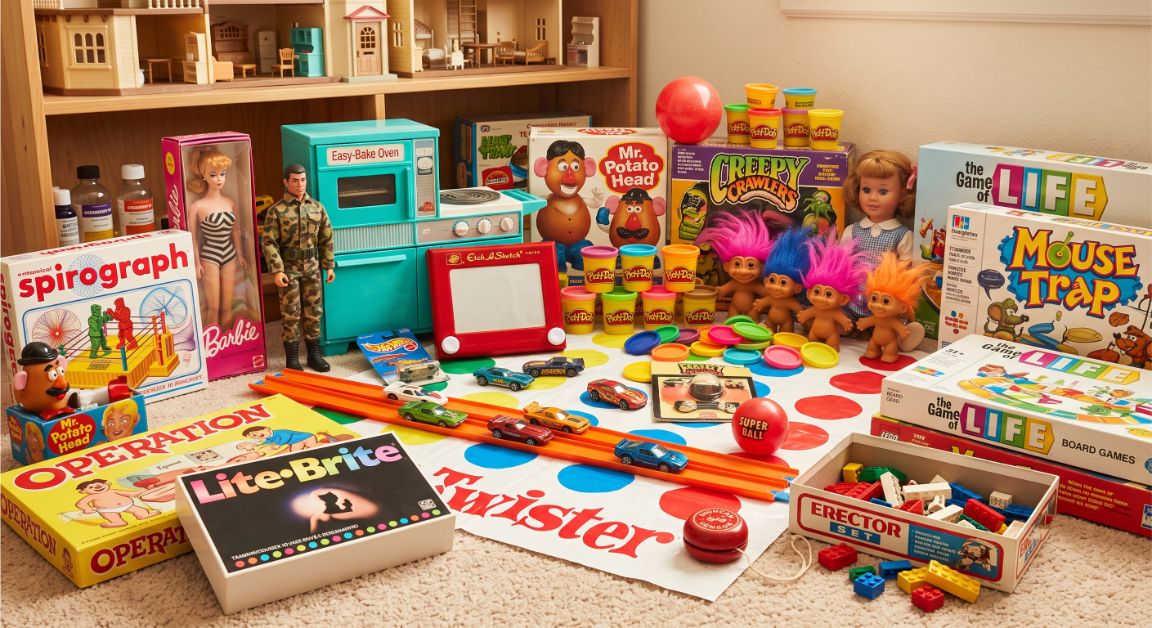
The decade mixed toys that had already been loved for years with new products that changed how children played. There were dolls and action figures, toy appliances, construction sets, miniature cars, art toys, board games, outdoor toys, and elaborate playsets that could take over an entire bedroom floor.
Some toys encouraged children to copy the adult world.
Others let them invent one of their own.
What Toys Were Popular in the 1960s?
Popular toys of the 1960s included:
- Barbie dolls and accessories
- G.I. Joe action figures
- Easy-Bake Oven
- Etch A Sketch
- Hot Wheels
- Matchbox cars
- Twister
- Operation
- Lite-Brite
- Spirograph
- Rock ’Em Sock ’Em Robots
- Mr. Potato Head
- Play-Doh
- Troll dolls
- Chatty Cathy
- Creepy Crawlers
- Super Ball
- Duncan yo-yos
- Erector Sets
- LEGO building sets
- Chemistry and science kits
- Dollhouses and miniature furniture
- Model cars and airplanes
- Board games such as The Game of Life and Mouse Trap
Not every child owned all of these.
Many toys were received only on birthdays or Christmas mornings. Others were shared between brothers and sisters, borrowed from neighbors, discovered at a cousin’s house, or admired through a store window and never actually brought home.
That was part of the experience too.
Sometimes the toy remembered most clearly was the one a child wanted for years.
Barbie’s World Grew During the 1960s
Barbie entered the market in 1959, just before the new decade began, but the 1960s were when her world expanded.
She was not a baby doll that needed feeding or rocking. She appeared as an older character with clothing, accessories, friends, careers, furniture, cars, and a lifestyle children could build through imagination.
The clothes mattered almost as much as the doll.
Tiny dresses came with miniature shoes, gloves, purses, hats, and other pieces that were easy to lose beneath a bed or inside a vacuum cleaner. Changing Barbie’s outfit could become an afternoon activity by itself.
Some children created houses from cardboard boxes. Others arranged furniture on the floor and built whole neighborhoods around the dolls they had.
Barbie also inspired long wish lists.
One doll was only the beginning.
There were more outfits to collect, vehicles to add, friends to introduce, and eventually houses large enough to occupy a corner of the room.
The Strong National Museum of Play notes that Barbie became a major success within a year of her 1959 introduction. Her popularity continued as Mattel released new outfits and versions tied to changing fashions and careers.
G.I. Joe Gave the Doll a New Name
When Hasbro introduced G.I. Joe in 1964, the company avoided calling him a doll.
He was marketed as an action figure.
That phrase mattered.
The original G.I. Joe stood about 12 inches tall and came dressed for military adventures. Children could change his uniforms, equip him with accessories, send him on missions, and create battles across bedrooms, yards, sandboxes, and living-room floors.
The figure had movable joints, which made it easier to pose him holding equipment, climbing, crawling, or standing at attention.
For many boys, G.I. Joe offered the same kind of character-based imaginative play that dolls had long offered girls, but with military clothing, vehicles, uniforms, and adventure equipment.
A single figure could become a soldier, explorer, pilot, sailor, or hero in a story that changed every time children played.
The National Museum of American History identifies 1964 as the year Hasbro introduced the G.I. Joe action figure.
The Easy-Bake Oven Made a Light Bulb Feel Powerful
The Easy-Bake Oven offered something few toys could promise.
At the end of play, there might be something to eat.
Kenner introduced the toy in 1963. Early versions used ordinary household light bulbs to heat small pans of cake or cookie mix.
The oven looked like a miniature kitchen appliance. Children mixed small packets, poured the batter into a little pan, pushed it through the oven, waited, and eventually pulled out a warm creation from the other side.
The finished cake was not always beautiful.
It might be uneven.
The frosting might be too thin.
The portion was small enough to disappear in a few bites.
None of that mattered much.
The excitement came from making something independently and watching a toy produce a real result.
For children who regularly saw adults baking in the family kitchen, the Easy-Bake Oven made that world feel accessible.
The Strong traces the toy’s inspiration to New York City pretzel vendors and notes that Kenner launched the oven in 1963 with baking mixes, utensils, small pans, and a turquoise-and-yellow design.
Etch A Sketch Rewarded Patience
Etch A Sketch looked simple.
A gray screen.
A red frame.
Two white knobs.
But creating even a basic picture required coordination.
One knob moved the line horizontally. The other moved it vertically. Turning both at once produced diagonal lines and curves, although rarely as smoothly as expected.
Children drew houses, names, staircases, boxes, faces, and patterns. Some became skilled enough to produce detailed pictures. Others struggled to make anything more complicated than a crooked rectangle.
The most satisfying part came at the end.
Turn it over.
Shake it.
The picture disappeared.
The screen was ready again.
The toy encouraged children to keep trying because mistakes were temporary. A bad drawing did not waste paper, and starting over required only a few seconds.
Smithsonian collection records connect the toy to a French design shown at the 1959 Nuremberg Toy Fair and later sold to the Ohio Art Company. It became one of the defining drawing toys of the early 1960s.
Matchbox Cars Fit Into a Pocket
Before Hot Wheels arrived, Matchbox cars already filled toy boxes and pockets.
The appeal was easy to understand.
They were small enough to carry almost anywhere, detailed enough to resemble real vehicles, and affordable enough that a child might build a collection one car at a time.
A windowsill became a road.
A rug pattern became a city map.
A cardboard box became a garage.
Children lined the cars up by color, traded them with friends, raced them down sloping surfaces, and argued over which one was fastest.
The boxes were part of the identity. Early vehicles were sold in packaging designed to resemble an actual matchbox, giving the brand its name and making each car feel like a small object worth collecting.
Matchbox was already enormously popular by 1960. The Strong reports that Lesney exported 70 million miniature vehicles that year, with American children becoming an important part of the market.
Hot Wheels Made Toy Cars Faster
Hot Wheels arrived in 1968 and made miniature cars look louder, faster, and more dramatic.
Instead of focusing only on realistic everyday vehicles, Mattel produced colorful custom cars inspired by American muscle cars and California hot-rod culture.
They had bright metallic finishes.
Wide wheels.
Low bodies.
Names and shapes that made them feel less like traffic and more like machines built for racing.
The flexible orange track changed the way children played with them.
Track could run across the floor, down stairs, over furniture, or through a plastic loop. Children adjusted the angle, changed the starting height, and repeated races to find out which car could travel the farthest.
The cars were small, but the setup could take over a room.
The Strong reports that Mattel released its first 16 Hot Wheels models in 1968. The cars were designed for speed, with low-friction axles and colorful finishes that separated them from their more realistic competitors.
Twister Turned People Into the Game Pieces
Most board games kept players seated around a table.
Twister put them on the floor.
The game used a large mat covered with colored circles. A spinner instructed players where to place a hand or foot.
At first, the positions seemed easy.
Then someone had to stretch across another player.
Arms crossed.
Legs shook.
Someone lost balance.
The whole group collapsed.
Twister worked because the players themselves became the pieces. There was little strategy to explain and no long list of rules to remember.
The game was physical, awkward, funny, and easy for people watching from the side to enjoy too.
The concept began in 1964 when inventor Reyn Guyer developed an idea involving a floor mat and people acting as game pieces. The project was refined with Charles Foley and Neil Rabens before reaching the public.
Operation Made a Buzz Feel Like Failure
Operation looked like a medical game, although it taught very little about actual medicine.
A cardboard patient lay on the board with strange ailments represented by small plastic pieces. Players used metal tweezers to remove them without touching the sides of each opening.
Touch the edge, and the game buzzed.
The patient’s red nose lit up.
Everyone knew the mistake had happened.
The challenge required a steady hand, especially when a room full of children was watching and waiting for the buzzer.
The names of the ailments made the game memorable too. They were silly rather than scientific, turning a tense test of coordination into something children could laugh about.
Operation was one of several 1960s games associated with designer Marvin Glass and his team, along with toys such as Rock ’Em Sock ’Em Robots and Lite-Brite. Smithsonian’s catalog of classic toys groups these products among the influential playthings of the period.
Rock ’Em Sock ’Em Robots Brought the Fight to the Table
Rock ’Em Sock ’Em Robots gave two players control of plastic boxers standing inside a small ring.
Each player pushed controls that made a robot punch.
The goal was simple.
Hit the other robot hard enough to make its head pop upward.
The match could be over quickly, but children rarely stopped after one round.
The robots were reset.
The players switched sides.
Someone demanded another chance.
The game was noisy, physical, and direct. It did not require reading, calculation, or much patience. The appeal was in controlling the punches and waiting for the sudden pop that ended the fight.
Lite-Brite Made Pictures Glow
Lite-Brite turned a dark room into part of the toy.
Children pushed small translucent pegs through black paper placed over a perforated screen. A light behind the board made the colored pieces glow.
Pattern sheets helped create recognizable pictures, but children could also ignore the templates and make their own designs.
The black paper hid most of the light.
The pegs released it in small points of color.
The finished image looked brighter and more impressive when the room lights were turned down.
The Strong explains that the toy’s creators were inspired in 1966 by a New York City window display made from hundreds of colored lights. They simplified the idea into a lighted board, black paper, and colored plastic pegs.
Spirograph Made Geometry Look Like Art
Spirograph used plastic gears, rings, pens, and paper to create repeating geometric designs.
A child placed a smaller gear inside or around a larger ring, inserted a pen into one of the holes, and moved it carefully around the edge.
The line crossed itself.
Then crossed again.
A pattern slowly appeared.
Changing the gear, pen hole, or starting position produced a different result. Layering colors made the design more complicated.
The toy rewarded patience and experimentation. A slipping gear could ruin the pattern, but a successful design looked far more precise than something most children could draw by hand.
Smithsonian records describe Spirograph as a geometric drawing toy introduced in 1966. It received Toy of the Year recognition in 1967.
Mr. Potato Head Finally Received a Plastic Potato
Mr. Potato Head had existed since the early 1950s, but the original version did not include the familiar plastic body.
Children were expected to push the face pieces into a real potato or another vegetable.
By 1964, the toy had gained the molded plastic potato most people recognize today.
The pieces were simple.
Eyes.
Ears.
Nose.
Mouth.
Hat.
Shoes.
Children could make a sensible face or place everything in the wrong position. An ear became a nose. A mouth appeared near the top of the head. Arms pointed in strange directions.
The toy encouraged experimentation because there was no correct final version.
The Strong notes that Hasbro introduced the plastic potato body in 1964 after years of selling the facial pieces separately.
Play-Doh Was Already a Toy-Box Essential
Play-Doh had been introduced during the 1950s, but it remained a major childhood toy throughout the 1960s.
The smell was unmistakable.
So was the texture.
Fresh Play-Doh was soft and smooth. Older Play-Doh became dry around the edges, especially when someone forgot to close the container properly.
Children rolled it, flattened it, cut it, squeezed it through tools, and mixed the colors together.
Mixing looked exciting at first.
Then everything eventually turned into a muddy brown or gray lump that could never be separated again.
Play-Doh sets added presses, molds, cutters, and the Fun Factory, which pushed the compound into long strands and shapes.
The Strong notes that Play-Doh Pete appeared on cans in 1960 and that the Fun Factory expanded what children could make with the modeling compound.
Toys Often Copied the Adult World
Many 1960s toys encouraged children to rehearse the roles adults expected them to fill.
Toy kitchens, miniature appliances, ironing sets, cleaning tools, dolls, and homemaking playsets were heavily marketed to girls.
Military figures, construction sets, chemistry kits, cars, rockets, and mechanical toys were more often marketed to boys.
The divide appeared in catalogs, commercials, packaging, and even the colors used on the boxes.
A Smithsonian examination of the Suzy Homemaker line shows how toy appliances were sold as miniature versions of household work. The line included ovens, mixers, dishwashers, vacuum cleaners, irons, and washing machines, with advertising presenting domestic work as an ideal form of play for girls.
Children did not always follow the marketing rules.
Sisters played with cars.
Brothers used the toy oven.
Friends mixed dolls, soldiers, blocks, animals, and household toys into the same invented story.
The packaging suggested one kind of play.
Children often created another.
Television Commercials Changed the Toy Box
The television had become one of the strongest ways to sell toys directly to children.
A toy that looked small on a store shelf could appear enormous on screen.
Cars raced faster.
Dolls seemed to speak more clearly.
Games produced constant laughter.
Action figures performed adventures that would require a child’s imagination once the box was opened.
Children watched the same commercials during cartoons and repeated the names, jingles, and promises afterward.
The commercial often showed exactly how the toy should be played with. But once children owned it, the toy rarely stayed inside that carefully presented story.
A car went off the track.
A doll wore the wrong clothes.
An action figure became a completely different character.
The advertisement created the desire.
Imagination took over from there.
Christmas Catalogs Made the Waiting Longer
Many children first encountered a toy through a catalog rather than a store.
The holiday catalog arrived weeks before Christmas, giving children time to study every page.
Toys were circled.
Pages were folded.
Numbers were written on lists.
A child returned to the same photograph again and again, imagining what the box might look like beneath the tree.
Large playsets were especially powerful on catalog pages.
The photograph showed every part assembled and every accessory in place. Children pictured the same scene at home, even when the actual toy required hours of assembly and took up more floor space than parents expected.
The catalog extended the experience beyond ownership.
Wanting the toy became an activity of its own.
Some of the Best Toys Were Still the Simplest
Not every popular toy was new.
Children still played with bicycles, jump ropes, marbles, jacks, yo-yos, balls, wagons, cards, crayons, model kits, blocks, and dolls passed down from older siblings.
Duncan yo-yos received a major television advertising campaign in the early 1960s, while contests continued to make tricks such as “walk the dog” and “rock the cradle” part of playground culture.
Simple toys lasted because they did not decide the entire game.
A ball could become part of dozens of activities.
Blocks could create a house one day and a spaceship the next.
A cardboard box could become a car, fort, store, stage, or secret place.
The toy industry was producing more complicated products, but children still knew how to build an afternoon around almost nothing.
Then vs. Now
| Then | Now |
|---|---|
| Toys were discovered through catalogs, television commercials, stores, and friends | Toys are also discovered through social media, videos, games, and online recommendations |
| Many toys relied almost entirely on imagination and physical movement | Digital features, apps, sounds, and connected play are common |
| Children often received major toys only on birthdays or holidays | Online shopping makes toys available throughout the year |
| A single toy could remain in use for years and pass between siblings | Product trends can change rapidly, although durable classics still survive |
| Instructions were usually printed on paper inside the box | Tutorials and demonstrations can be watched online |
| Friends often gathered around one physical toy or board game | Play can be physical, online, remote, or divided across separate devices |
| Repairs involved tape, glue, replacement parts, or accepting the damage | Electronic toys may become difficult to use when batteries or digital services fail |
Why 1960s Toys Still Matter
The most memorable toys of the 1960s did not all work in the same way.
Some copied the adult world.
Some turned art into a game.
Some encouraged competition.
Some created characters and stories.
Some let children build, bake, draw, race, collect, dress, or experiment.
What connected them was the amount of imagination children had to bring.
The box showed what the toy could do.
The child decided what happened next.
A G.I. Joe figure did not move unless someone moved him.
A Barbie doll did not have a conversation unless someone supplied both voices.
A Hot Wheels car needed a track, a slope, or a hand pushing it forward.
A Lite-Brite picture took time.
An Etch A Sketch line required concentration.
Even a board game needed people sitting close enough to argue over the rules.
The toys became connected to places and people.
A bedroom floor.
A friend’s basement.
A grandparent’s house.
A kitchen table.
A Christmas morning.
A rainy afternoon when there was nowhere else to go.
That is why seeing an old toy can bring back more than the object itself.
It can bring back the room where it was played with.
The person who gave it to you.
The sibling who lost one of the pieces.
The friend who always wanted the same car.
And the version of yourself who believed a cardboard box contained an entire world.
Quick Answers About 1960s Toys
What were the most popular toys of the 1960s?
Some of the decade’s most remembered toys include Barbie, G.I. Joe, Easy-Bake Oven, Etch A Sketch, Hot Wheels, Matchbox cars, Twister, Operation, Lite-Brite, Spirograph, Troll dolls, Play-Doh, Mr. Potato Head, Rock ’Em Sock ’Em Robots, and various model and construction sets.
What toys were introduced during the 1960s?
Notable introductions included G.I. Joe in 1964, Easy-Bake Oven in 1963, Hot Wheels in 1968, Spirograph in 1966, and several games and creative toys that became strongly associated with the decade.
What toys did children play with outside?
Common outdoor toys included bicycles, jump ropes, balls, yo-yos, roller skates, wagons, jacks, marbles, water toys, flying discs, and simple playground equipment.
Were toys different for boys and girls?
Toy companies frequently marketed dolls and household playsets to girls while promoting cars, military figures, construction sets, and science toys to boys. In actual homes and neighborhoods, children often ignored those divisions and played with whatever was available.
Why are 1960s toys collectible today?
Many survive as reminders of childhood, while original packaging, missing accessories, short production runs, and the condition of older materials can make particular examples desirable to collectors.
Sources & Further Reading
- Barbie — The Strong National Museum of Play history of Barbie’s 1959 introduction, early success, fashions, and changing career roles.
- G.I. Joe Figure — National Museum of American History collection record documenting Hasbro’s introduction of the G.I. Joe action figure in 1964.
- Easy-Bake Oven — The Strong’s account of the light-bulb-powered oven, its 1963 debut, accessories, colors, and long-running popularity.
- Etch A Sketch — Smithsonian collection background on the French drawing-toy design that became the familiar Etch A Sketch.
- Hot Wheels — The Strong’s history of Mattel’s original 1968 cars, custom styling, low-friction wheels, racing track, and early success.
- Twister — Background on the development of the floor game in which the players themselves became the playing pieces.
- National Toy Hall of Fame Inducted Toys — Historical profiles of influential toys, including Lite-Brite, Play-Doh, Matchbox cars, yo-yos, and other childhood classics.
- Suzy Homemaker: A Slice of Life From the 1960s — Smithsonian examination of miniature household appliances and the gender roles reflected in 1960s toy advertising.
Do You Remember This?
Which toy from the 1960s did you want most?
Maybe you remember baking a tiny cake, racing cars across the floor, shaking away an Etch A Sketch drawing, dressing a doll, building a model, or studying the holiday catalog for weeks.
Was there a toy everyone else seemed to have except you?
Do you remember this? Share your memory below.

Join the Conversation
What Do You Remember?
Did this story bring back a memory? Tell us below, or share a longer story on the Memory Wall.
Share a Full Memory