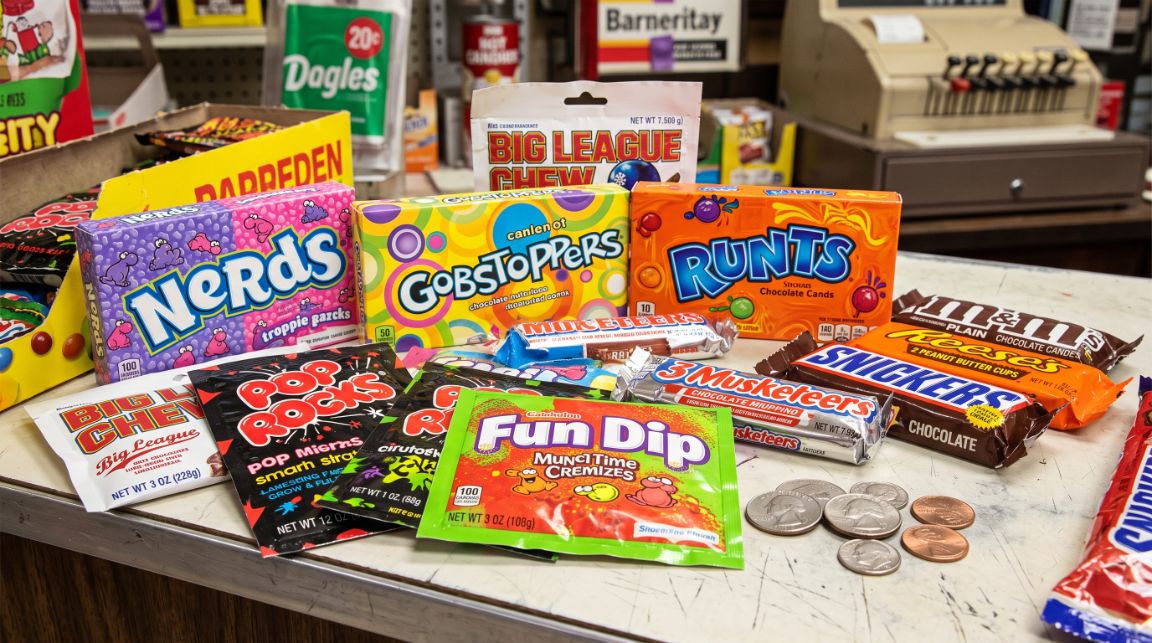
Candy in the 1980s was rarely just something sweet.
It was what you bought after school with the coins left in your pocket.
It was what appeared beside a sandwich in a lunchbox.
It was traded at the cafeteria table, shared during a movie, poured into your hand at the arcade, or carefully counted after Halloween.
The decade had chocolate bars and gum that had already been around for years, but it also brought a new wave of candy that felt louder, brighter, more sour, and more playful.
Some came in tiny boxes with two flavors.
Some were shaped like fruit.
Some stretched, cracked, fizzed, or turned your tongue a different color.
And some became so connected to movies and television that remembering the candy also brings back the screen you first saw it on.
What Candy Was Popular in the 1980s?
The candy aisle of the 1980s mixed older favorites with products that were new or newly popular during the decade.
Children still reached for familiar chocolate bars, lollipops, gum, taffy, and hard candy. But the shelves were also filling with more intensely flavored fruit candy, sour coatings, unusual shapes, bright packaging, and small portions designed to be carried in a pocket or backpack.
Some of the candies strongly associated with the decade include:
- Nerds
- Runts
- Airheads
- Sour Patch Kids
- Skittles
- Reese’s Pieces
- Pop Rocks
- Ring Pops
- Fun Dip
- Bubble Yum
- Now and Later
- Jolly Rancher
- Starburst
- Fruit Stripe gum
- Bottle Caps
- Gobstoppers
- Laffy Taffy
Not all of these candies were invented during the 1980s.
Many had appeared earlier but remained a regular part of childhood throughout the decade. What mattered to kids was not the official launch date.
It was whether the candy was available at the corner store, movie theater, supermarket checkout, school event, or neighborhood gas station.
Nerds Made a Tiny Box Feel Exciting
Nerds looked different from most candy on the shelf.
The pieces were small, irregular, crunchy, and intensely flavored. The box was divided into two sides, usually with a different flavor in each compartment.
A child could pour one flavor into a hand.
Then the other.
Or open both sides and mix them together.
The original packaging made the act of eating the candy almost as memorable as the candy itself.
Nerds were developed in the early 1980s and launched nationally during the middle of the decade. Their small dual-compartment box was shaped by research into how children held, poured, and shared candy.
For many people, the sound is part of the memory.
The little pieces rattling inside the box.
The sliding cardboard opening.
The sudden rush of candy when the box was tipped too far.
Nerds were easy to carry, easy to share, and almost impossible to eat quietly.
Runts Turned Fruit Into Candy Shapes
Runts were another candy that looked made for a child’s imagination.
Instead of simple round pieces, they came shaped like tiny fruits.
Bananas.
Oranges.
Strawberries.
Cherries.
Limes.
The shape mattered.
Children sorted them, traded them, saved their favorite flavors, or complained about whichever fruit seemed to take up most of the box.
The banana pieces were especially easy to recognize, even before anyone tasted them.
Runts arrived in 1982 under the Willy Wonka candy line. Their fruit shapes and crunchy texture made them feel like something between a vending-machine candy and a tiny collection of toys.
They were not eaten quickly by everyone.
Some kids poured the box straight into their mouths.
Others selected one shape at a time.
Reese’s Pieces Became Movie Candy
Reese’s Pieces were introduced before the 1980s, but the decade made them unforgettable.
The orange, yellow, and brown candy pieces became closely tied to the 1982 movie E.T. the Extra-Terrestrial. Their appearance in the film turned a candy into part of a major pop-culture memory.
For children, the connection was simple.
It was the candy from the movie.
The pieces were small enough to pour into a hand, carry in a bag, or share during a film. They had a crisp shell and a peanut-butter center that made them different from ordinary chocolate candies.
Even people who do not remember when Reese’s Pieces first appeared may remember seeing them scattered along the ground as Elliott tried to lead E.T. out of hiding.
The candy and the scene became difficult to separate.
Skittles Brought More Color to the Candy Aisle
Skittles had been imported into the United States before the 1980s, but U.S. manufacturing began in 1981. The brightly colored fruit-flavored pieces soon became a familiar part of the decade’s candy landscape.
They looked a little like chocolate candies from a distance, but the inside was chewy and fruity.
A bag could be divided by color.
Flavors could be eaten one at a time.
Or everything could be poured together without much thought.
Children sometimes claimed one color was clearly better than all the others, even when friends disagreed.
The packaging was bright, the pieces traveled well, and the candy suited places where kids wanted something that lasted longer than a single chocolate bar.
Airheads Made Candy Feel Like a Challenge
Airheads arrived during the middle of the decade with long, flat pieces of chewy fruit candy.
The wrappers were bright.
The flavors were bold.
The candy could be folded, stretched, twisted, or bitten into small pieces.
Some children rolled it into a ball before eating it. Others tried to make it last as long as possible.
The texture was a major part of the appeal.
It was not hard candy.
It was not gum.
It was not quite traditional taffy either.
It felt like something made for playgrounds, concession stands, swimming pools, sporting events, and convenience-store counters.
The individual wrapping also made Airheads easy to sell one at a time, which mattered when children were buying candy with a small amount of money.
Sour Candy Became More Important
The 1980s helped make sourness a bigger part of children’s candy.
Candy had always included tart flavors, but products such as Sour Patch Kids made the sour coating itself part of the experience.
The first bite could make someone’s face tighten.
Then the sweetness arrived.
Kids dared friends to eat several pieces at once or argued about which flavor was the most sour.
Sour Patch Kids reached the U.S. market during the 1980s after an earlier version had been sold in Canada. The product became closely associated with the decade’s growing appetite for bolder fruit flavors and playful candy concepts.
Sour candy was not only about taste.
It was also about reaction.
The face someone made.
The challenge.
The claim that it was not sour at all.
Older Candy Still Filled the Shelves
The 1980s candy experience was not limited to products introduced during the decade.
Many children regularly bought candy that had existed for years.
Chocolate bars remained dependable choices.
Gum was still a major part of the candy rack.
Hard candies could last through a long walk home.
Taffy and fruit chews were easy to carry.
Pop Rocks still felt strange enough to seem like an experiment every time the package was opened.
Ring Pops turned candy into something worn on a finger.
Fun Dip came with flavored powder and an edible dipping stick.
Bubble Yum promised large bubbles, even when the bubble ended up stuck to someone’s face.
The decade’s candy aisle felt crowded because old favorites and newer products sat beside one another.
A child did not care which generation a candy belonged to.
It only mattered whether it tasted good and whether there was enough money to buy it.
Corner Stores Made Small Purchases Feel Important
The corner store, small grocery, drugstore, or neighborhood market was where many candy memories began.
Candy was often placed near the register where children could see it.
The choice might be made while a parent bought milk, bread, cigarettes, or a newspaper.
Sometimes a child was sent to the store alone with a short grocery list and a little extra money.
That extra money created an important question.
What could you afford?
A piece of gum?
A candy bar?
A small box of Nerds?
Something to share?
Something to hide until later?
The prices may have been small, but the decision felt serious.
Children studied the shelf, compared options, changed their minds, and tried to get the greatest possible amount of candy from the coins they had.
Lunchbox Candy Was a Form of Currency
A piece of candy in a school lunch could change the whole meal.
It sat beside the sandwich, fruit, chips, or drink like a small reward waiting at the end.
But candy did not always stay with the child who brought it.
The cafeteria table became a trading floor.
One candy might be exchanged for cookies.
A piece of gum might be saved for recess.
A child with several small candies suddenly had bargaining power.
The best lunchbox candy was easy to divide, trade, hide, or save.
Tiny boxes and individually wrapped pieces worked especially well.
Candy also revealed which parents packed treats regularly and which families considered them something for special occasions.
A child who rarely found candy in a lunchbox remembered the days when it appeared.
The Arcade and Movie Theater Had Their Own Candy
Candy tasted different when it came from an arcade or movie theater.
At the arcade, a child might spend most of the money on game tokens and save just enough for something small.
At the theater, boxed candy felt connected to the film.
The box rested on a lap.
Pieces were poured carefully during quiet scenes.
Someone always shook the package louder than they realized.
Theater boxes also made candy feel larger and more official than a small convenience-store package.
Nerds, Runts, Reese’s Pieces, and other pourable candies suited movie watching because they could last through more than one scene.
Unless someone ate the whole box during the previews.
Candy Commercials Made Everything Look Better
Television advertising helped turn candy into part of children’s culture.
A candy commercial could appear between cartoons and make a familiar product look new again.
The colors were brighter.
The reactions were bigger.
The candy seemed more exciting than it did under the grocery-store lights.
Jingles, mascots, slogans, and exaggerated reactions stayed in children’s minds. The next time they stood near the candy rack, the commercial was already doing part of the selling.
Candy companies also benefited from connections to movies, television characters, promotions, and limited-edition packaging.
The wrapper was not only there to protect the candy.
It helped tell children what kind of experience they were supposed to have.
Fun.
Sour.
Wild.
Chewy.
Crunchy.
Out of control.
Halloween Brought Everything Together
Halloween was when the full candy aisle seemed to arrive at home.
Children poured bags onto the floor and began sorting.
Chocolate in one pile.
Gum in another.
Fruit candy together.
Things nobody wanted pushed to the side.
The best pieces were counted.
Duplicates were traded.
Older siblings sometimes claimed a tax.
Parents quietly removed anything they considered suspicious or unsuitable.
Small packages of Skittles, Reese’s Pieces, gum, hard candy, chews, and chocolate bars all became part of the same collection.
The candy could last for days or weeks, depending on the child.
Some ate the favorites first.
Others saved the best pieces until the end.
Either way, the pile slowly disappeared.
The Wrappers Were Part of the Memory
The candy itself mattered, but so did the packaging.
The bright boxes.
The shiny plastic.
The paper that twisted at both ends.
The small opening that never closed properly afterward.
The powder left inside a pouch.
The wrapper that stuck to warm candy.
Children recognized products from a distance because of color and shape.
A box of Nerds did not look like a bag of Skittles.
A Ring Pop did not look like anything else.
An Airhead wrapper gave a strong clue about the flavor inside.
The packaging helped turn each candy into its own little object, with rules about how it should be opened, held, shared, and eaten.
Then vs. Now
| Then | Now |
|---|---|
| Candy was often bought one piece or one small package at a time | Larger bags, multipacks, and online orders are common |
| Kids chose candy with coins at a neighborhood store | Purchases are often made by adults during larger shopping trips |
| Commercials, movies, and cartoons introduced new candy | Social media, creators, challenges, and online trends now play a major role |
| Lunchbox candy was traded face to face | Snacks are more likely to be restricted or managed by school policies |
| Flavors centered on chocolate, fruit, gum, taffy, and early sour candy | Extreme sourness, unusual combinations, and novelty textures have expanded |
| Packaging was opened and eaten immediately | Many modern packages are resealable and designed for longer snacking |
Why 1980s Candy Is Still Remembered
People remember 1980s candy because it was connected to independence.
The freedom to walk into a store with your own money.
The freedom to choose one thing.
The freedom to trade it, share it, save it, or eat it before getting home.
Candy was also connected to places.
The school cafeteria.
The movie theater.
The arcade.
The swimming pool.
The gas station.
The corner store.
The living room during Saturday morning cartoons.
A particular candy can bring back all of those surroundings at once.
The flavor may be familiar, but the memory is larger than the taste.
It is the sound of the wrapper.
The coins on the counter.
The friend sitting beside you.
The show on television.
The walk home after school.
That is why a tiny box, a bright wrapper, or one artificial fruit flavor can suddenly make the 1980s feel close again.
Quick Answers About 1980s Candy
What candy came out in the 1980s?
Candy introduced or broadly launched during the decade included Nerds, Runts, Airheads, and Sour Patch Kids. Skittles also began U.S. manufacturing in 1981, while Reese’s Pieces became much more famous after appearing in E.T. in 1982.
What candy was popular with children in the 1980s?
Popular choices included Nerds, Skittles, Reese’s Pieces, Runts, Airheads, Sour Patch Kids, Pop Rocks, Fun Dip, Ring Pops, Bubble Yum, Now and Later, Starburst, Jolly Rancher, and a wide range of chocolate bars.
Why is 1980s candy so nostalgic?
The candy was closely connected to school lunches, neighborhood stores, Halloween, arcades, movies, television commercials, and the first small purchases many children made with their own money.
Was all popular 1980s candy invented during the decade?
No. Many candies remembered from the 1980s had been introduced earlier. They are associated with the decade because they remained widely available and were part of everyday childhood experiences.
Do You Remember This?
What candy did you always choose in the 1980s?
Maybe you remember pouring Nerds into your hand, saving the banana Runts, stretching an Airhead, trading lunchbox candy, or buying something small with the coins left in your pocket.
Which candy would you bring back exactly as it was?
Do you remember this? Share your memory below.



Join the Conversation
What Do You Remember?
Did this story bring back a memory? Tell us below, or share a longer story on the Memory Wall.
Share a Full Memory