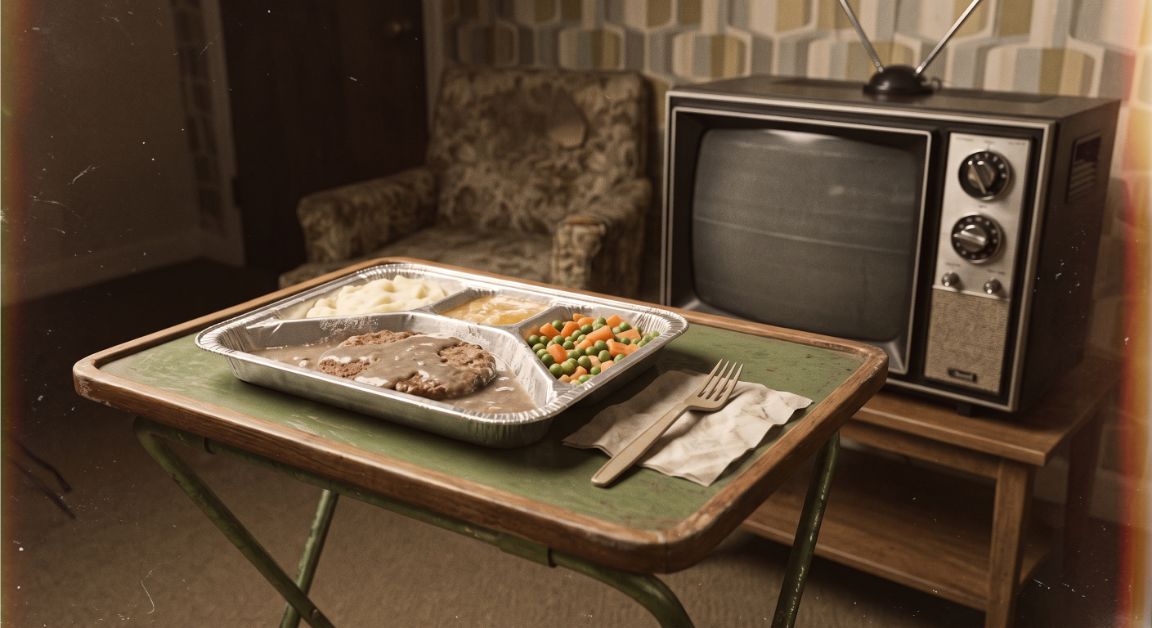
A TV dinner was more than a frozen meal.
It was supper arranged in neat little compartments. It was an aluminum tray warming in the oven. It was a folding table placed in front of the couch and the rare permission to eat while watching television.
For some families, TV dinners were saved for busy nights. For others, they appeared when parents were going out, when nobody wanted to cook, or when a favorite program made eating in the living room feel like a special event.
Swanson helped popularize the branded TV dinner in 1954 by combining a complete frozen meal, a disposable divided tray, and America’s growing excitement about television.
The product promised less preparation, fewer dishes, and a meal that could be eaten away from the traditional dinner table.
What Was a TV Dinner?
A classic TV dinner was a complete frozen meal packaged in a compartmented tray.
The early trays usually separated the main dish from the vegetables, potatoes, and sometimes dessert. The meal could be heated in its package and eaten directly from the same tray.
That was a meaningful change.
There was no serving bowl for the vegetables.
No separate pan for the potatoes.
No dinner plate waiting to be washed afterward.
The meal went from freezer to oven and then directly to the person eating it.
The compartments were also part of the appeal, especially for children who did not want gravy running into their peas or vegetables touching dessert.
Frozen Dinners Existed Before the TV Dinner
The idea of freezing a complete meal did not begin with Swanson.
Maxson Food Systems produced compartmented frozen meals called Strato-Plates during the 1940s for airline passengers. Other companies and individuals also contributed to the development of prepared frozen meals.
That is why the question of who invented the TV dinner does not have one simple answer.
Several people and companies helped shape the idea, including Maxson Food Systems, the Swanson brothers, and Swanson employee Gerry Thomas.
Swanson’s achievement was turning the concept into a widely recognized household product.
The company connected the frozen meal to one of the most exciting objects entering American homes: the television.
The Swanson TV Dinner Arrived at the Right Time
Swanson introduced its frozen TV dinner nationally in 1954.
The original meal followed a familiar turkey-dinner format, with turkey, cornbread dressing, peas, and sweet potatoes arranged in separate sections of an aluminum tray.
The packaging was designed to resemble a television set, helping connect the meal with the new habit of watching television at home.
The idea quickly caught on. Swanson sold about ten million trays during its first full year of production, and competing food companies soon introduced frozen dinners of their own.
The timing was almost perfect.
Television ownership was growing rapidly. Freezers were becoming more useful parts of household kitchens. Packaged convenience foods were increasingly marketed as ways to reduce preparation and cleanup.
The TV dinner brought all of those changes together in one small tray.
The Aluminum Tray Was Part of the Experience
People who remember early TV dinners often remember the tray as clearly as the food.
It was light but stiff.
The foil made a sound when it was peeled back.
The edges became hot in the oven.
Each part of the meal had its own space, although the gravy sometimes crossed the borders anyway.
The tray made an ordinary frozen meal feel different from leftovers placed on a plate. It looked organized and complete, almost like a tiny cafeteria lunch made for one person.
There was also something satisfying about revealing the meal after it had cooked.
One section held the meat.
Another held the potatoes.
Another held peas, corn, or another vegetable.
Later dinners sometimes included a small dessert that had somehow baked in the same tray as everything else.
The dessert compartment could be the most anticipated part of the entire meal.
Eating Dinner in Front of the Television
The name “TV dinner” did not hide what the meal was for.
It encouraged families to move supper out of the kitchen or dining room and into the living room.
By 1960, nearly 90 percent of American homes had a television. Folding TV tray tables became an inexpensive way to hold a meal in front of the set and offered an alternative to sitting around the family dinner table.
A family might place several trays around the couch.
Someone balanced a drink beside the hot aluminum container.
Someone warned the children not to spill.
Someone adjusted the antenna or changed the channel before sitting down.
Then the program began.
The meal and the television became part of the same memory.
When a Frozen Dinner Felt Like a Treat
TV dinners were marketed as convenient, but children did not always see them as a shortcut.
To a child, an individual meal could feel special.
Everyone had their own tray.
Nobody had to share the potatoes.
The food came in sections.
There might be a brownie, cobbler, or other small dessert waiting in one corner.
Some children were allowed to choose their own dinner from the grocery-store freezer. One person wanted fried chicken. Another wanted turkey. Someone else chose Salisbury steak because the picture on the box looked better.
The meal might not have tasted like something cooked from scratch, but that was not always the point.
It was different.
Different could feel exciting.
The Familiar TV Dinner Foods
Frozen-dinner menus expanded well beyond the original turkey meal.
Over the years, grocery-store freezers filled with options such as:
- Salisbury steak with gravy
- Fried chicken
- Meatloaf and mashed potatoes
- Turkey with stuffing
- Macaroni and cheese
- Fish with vegetables
- Enchiladas and other internationally inspired meals
- Small brownies, fruit cobblers, or cakes
Not every part cooked evenly.
The potatoes might still be cool while the dessert was dangerously hot. Peas could become dry around the edges. Gravy sometimes formed a skin on top.
People remember those imperfections too.
They were part of the experience.
TV Dinners Changed With the Microwave
Early TV dinners were designed for conventional ovens, which worked well with aluminum trays but required patience.
The microwave changed that.
As microwave ovens became common household appliances, frozen-meal companies began replacing aluminum with microwave-safe packaging.
Swanson moved toward plastic trays during the 1980s as microwave reheating became more common.
A meal that once required a longer wait in the oven could now be ready in minutes.
That made frozen dinners more convenient, but it also changed the ritual.
There was less waiting.
Less foil.
Less of the distinctive aluminum tray people associated with the original TV dinner.
The meal moved closer to the modern frozen entrée we recognize today.
Then vs. Now
| Then | Now |
|---|---|
| Meals were heated in divided aluminum trays | Most frozen meals use microwave-safe plastic, paper, or film |
| Preparation often required a conventional oven | Many meals are ready after a few minutes in the microwave |
| The product was closely associated with watching family television | Frozen meals are eaten at home, at work, or wherever convenient |
| Choices centered on meat, potatoes, vegetables, and dessert | Options now include bowls, international dishes, diet meals, and high-protein recipes |
| Families often watched the same scheduled program together | Household members may eat while watching separate screens |
| The tray itself was part of the memory | Modern packaging is designed mainly for speed and portability |
Did TV Dinners Replace Family Meals?
TV dinners did not suddenly end the traditional family supper.
Many households still cooked regularly and gathered around the kitchen or dining-room table. Frozen dinners were often an occasional solution rather than an everyday meal.
But they represented a larger shift.
Food could now be prepared individually.
Family members did not always need to eat the same dish.
Dinner could follow the television schedule instead of requiring everyone to gather around the table.
Convenience became more important in household food marketing, and packaged meals offered an answer for busy evenings.
The TV dinner did not create every change in family life, but it fit neatly into changes already happening.
Why TV Dinners Still Bring Back Memories
People rarely become nostalgic simply because a meal was convenient.
They become nostalgic because of what surrounded it.
The sound of the foil.
The hot tray balanced on a folding table.
The television glowing across the room.
A favorite show beginning just as dinner was ready.
A parent saying this was a special night.
A sibling trying to trade vegetables for dessert.
The frozen meal became attached to the evening.
That is why an old TV dinner package or aluminum tray can bring back more than the taste of Salisbury steak or mashed potatoes.
It can bring back the room.
The couch.
The television.
The people who were sitting nearby.
Quick Answers About TV Dinners
When did TV dinners become popular?
Swanson introduced its branded TV dinner nationally in 1954, when television ownership and interest in convenience foods were both growing quickly.
Earlier frozen complete meals existed, but Swanson made the concept a mass-market household product.
What was in the original TV dinner?
The best-known original Swanson meal included turkey, cornbread dressing, peas, and sweet potatoes in separate sections of an aluminum tray.
Why were they called TV dinners?
The name and television-shaped packaging connected the meal with the growing habit of eating while watching television.
Swanson promoted it as a convenient meal that suited life around the household television set.
Did people cook TV dinners in the oven?
Early TV dinners were heated in conventional ovens because their containers were made from aluminum.
Microwave-safe plastic trays became common later as microwave use increased.
Sources & Further Reading
- No Work, No Dishes — National Museum of American History background on Swanson TV dinners, aluminum trays, television viewing, and TV tray tables.
- Who Invented the TV Dinner? — Library of Congress explanation of the people and companies involved in developing complete frozen meals.
- Food Culture, Supermarkets, and Packaging — Smithsonian discussion of early TV dinner packaging and the later transition to plastic microwave trays.
- A Brief History of the TV Dinner — Historical overview of the Swanson product, its rapid commercial success, and the disputed story of its creation.
Do You Remember This?
Did your family eat TV dinners in front of the television?
Maybe you remember choosing your own meal at the grocery store, peeling back the foil, waiting for the dessert compartment, or balancing the hot tray while a favorite show began.
Which dinner did you always choose?
Do you remember this? Share your memory below.



Join the Conversation
What Do You Remember?
Did this story bring back a memory? Tell us below, or share a longer story on the Memory Wall.
Share a Full Memory