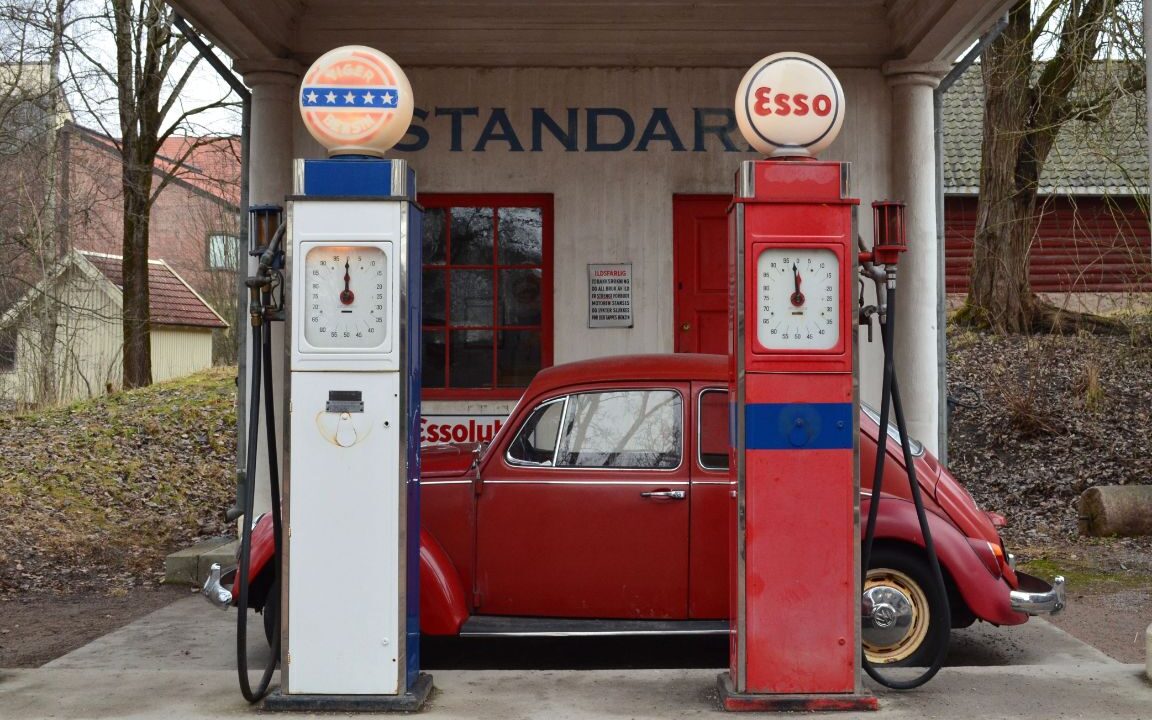
Before gas stations became quick places to tap a card, fill the tank, and leave, they were often part of the road trip itself.
A stop for gas meant more than fuel.
It meant everyone could stretch their legs.
It meant someone used the restroom.
It meant a parent checked the map.
It meant kids looked for snacks, postcards, gum, or something small to carry back to the car.
For a few minutes, the trip paused.
Then the family got back in, the engine started again, and the road continued.
The Car Pulled In and Everyone Had a Job
A gas station stop had its own routine.
The driver watched the pump.
Someone checked the oil.
Someone cleaned the windshield.
Someone opened the trunk for a cooler, a bag, or a jacket.
Kids were told to stay close, not wander too far, and hurry up if they needed the restroom.
Sometimes an attendant came out to help.
They filled the tank.
They washed the windshield.
They checked under the hood.
They gave directions if someone was unsure which road to take next.
The stop did not always take long, but it felt important.
The family was between places.
Not home.
Not yet at the destination.
Just on the road.
The Map Rack Was Part of the Adventure
Inside many gas stations, there was a rack full of maps.
Some were folded neatly. Some had bright state covers. Some showed highways, parks, towns, scenic routes, and places that looked exciting simply because they were printed on paper.
Parents picked up maps for the next state.
Kids looked at postcards.
Someone might ask how far away the next stop was.
Someone else might say they already knew.
The map rack made the road feel bigger.
A child could see the state line.
The long highway.
The names of towns they had never heard before.
The route that curved toward a place where the family would sleep that night.
The Snack Aisle Was Never Just an Aisle
For kids, the best part of the gas station was often inside.
There were chips, candy, gum, cold drinks, peanuts, crackers, and little shelves of things nobody needed but everyone wanted.
A parent might say, “Choose one.”
That was enough to make the stop memorable.
One candy bar.
One soda.
One bag of chips for the back seat.
The snack became part of the trip.
Years later, someone might not remember the exact route. But they remember the orange soda, the gum, the paper bag, or the candy that melted before the family reached the motel.
The Restroom Stop Everyone Knew
No one planned a road trip around restrooms, but everyone remembered them.
The key might hang from a large wooden block.
There might be a sign that said “Customers Only.”
There might be a long hallway, an outside door, or a small building around the side.
Parents always seemed to know when it was time to stop, even before the kids did.
And once the car started moving again, someone almost always said they needed to go.
That was part of the rhythm too.
The family laughed.
The driver sighed.
The next stop was already being planned.
Then vs. Now
| Then | Now |
|---|---|
| Gas stations often included attendants, maps, and local directions | Most stops are self-service and guided by digital maps |
| Travelers unfolded paper maps at the counter or by the car | GPS gives directions before the car even leaves home |
| Snacks were chosen from a small roadside shelf | Food and drinks can be planned, ordered, or delivered in advance |
| Windshields were often cleaned during the stop | Many drivers handle every part of the stop themselves |
| A gas station could become part of the road-trip memory | Stops are often treated as quick interruptions |
Not everything about the old way was easier.
Cars needed more attention.
Directions could be confusing.
The restrooms were not always great.
But the stop gave families a little break from the road.
The Station Was Part of the Landscape
Old gas stations often had a look of their own.
A tall sign.
Bright company colors.
A small office.
A canopy over the pumps.
A service bay around the side.
Some sat beside diners or motels. Some stood alone at the edge of town. Some were near a highway exit where travelers could see the sign from far away.
For many people, the station was one of the first signs that the family had reached somewhere new.
Different state.
Different town.
Different road.
Same need for gas.
Why These Stops Stay in Memory
People remember gas stations because they were part of the in-between moments.
They were not the destination.
They were not home.
They were the place where the family paused, looked around, bought something small, checked the map, and kept going.
The smell of gasoline.
The sound of the pump.
The cool air inside the shop.
The map folded across the dashboard.
The snack chosen for the back seat.
The car pulling away again.
These things seemed ordinary at the time.
But they became part of the story of getting somewhere together.
Sources & Further Reading
- Route 66 Overview — National Park Service overview of the hotels, gas stations, restaurants, and roadside businesses that lined historic Route 66.
- Route 66 Roadside Architecture — National Park Service background on the distinctive commercial architecture that developed along the route, including historic gas stations.
- John Margolies Roadside America Photograph Archive — Library of Congress collection documenting roadside commercial structures, including gas stations, motels, diners, and highway landmarks.
Do You Remember This?
What do you remember about gas-station stops on family trips?
Maybe it was the map rack, the snacks, the bathroom key, the old pumps, the windshield cleaning, or the feeling that the trip was about to begin again.
Do you remember this? Share your memory below.
Join the Conversation
What Do You Remember?
Did this story bring back a memory? Tell us below, or share a longer story on the Memory Wall.
Share a Full Memory